Choosing a software development company is a lot like hiring a contractor to build your house. Every portfolio looks great. Every team promises to finish on time. You only find out who was right a few months in, when the walls are already up.
That’s why most lists of the top software development companies don’t help much. They praise every vendor and skip the part you actually need: who fits what.
This guide does it differently. We put ten custom software development companies’ side by side and asked each one the same questions. What do they really build? Which projects play to their strengths? And what should you double check before you sign?
You’ll also get a simple framework for matching your project to the right kind of partner, five questions that expose weak vendors fast, and answers to the questions buyers ask most.
What earns a company a spot on this list?
A great homepage proves nothing. A shipped product does.
Every company here made the cut on real work: published case studies, named projects, and a clear track record in the kind of software they build. For each one, we look at what they build, who they build it for, and where they shine. Then we flag the one thing worth checking before you sign.
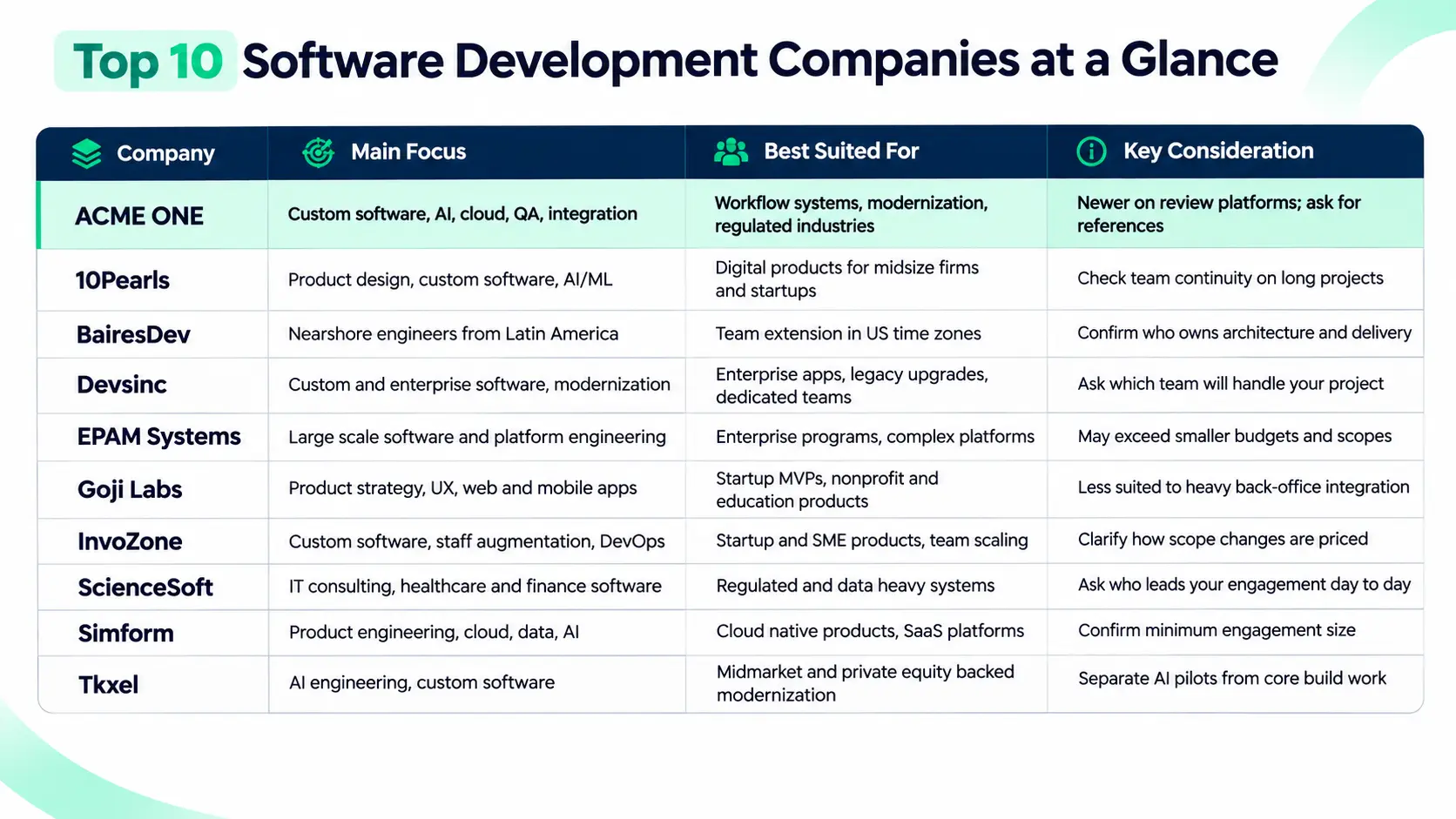
Top 10 software development companies to consider in 2027
1. ACME ONE
An engineering partner for business software that has to fit messy, real-world workflows.
ACME ONE is headquartered in Dubai, with an engineering team in Pakistan and clients across the US, UK, and Middle East. It offers custom software development, AI, cloud architecture, DevOps, quality assurance, and system integration. Its case studies range from a U.S. customs compliance platform for Acelynk to microservices for a reinsurance business and a healthcare platform rebuilt in 7.5 weeks.
Project fit: Workflow heavy business systems, insurance and compliance software, healthcare platforms, and modernization of existing applications.
What to consider: ACME ONE is newer to review platforms like Clutch, so public reviews are still limited. Ask for client references and walk through a case study close to your project.
2. 10Pearls
Design and engineering under one roof, with two decades of practice behind it.
10Pearls was founded in 2004 and is based in Vienna, Virginia. It offers custom software development, product design, AI and machine learning, cloud, and mobile and web development across healthcare, financial services, energy, education, and retail.
Project fit: Midsize companies and funded startups building customer facing digital products that need strong design and engineering together.
What to consider: 10Pearls delivers through global teams. On long projects, ask how they keep the same engineers on your account.
3. BairesDev
Latin American engineering talent that works on US hours.
BairesDev was founded in 2009 and is headquartered in San Francisco. It provides nearshore engineers from Latin America through staff augmentation, dedicated teams, and full project outsourcing.
Project fit: US companies that want to add engineers quickly, with real time collaboration in nearby time zones.
What to consider: BairesDev’s model is built around supplying talent. If you need a partner to own architecture and delivery risk, get that scope in writing.
4. Devsinc
A large delivery team built in Lahore, now serving clients worldwide.
Devsinc was founded in 2009 in Lahore, Pakistan, which remains its global delivery center. It serves clients across North America, the UAE, MENA, and APAC with custom and enterprise software, legacy modernization, API integration, and staff augmentation.
Project fit: Enterprise applications, legacy upgrades, and companies that want a dedicated offshore team for ongoing work.
What to consider: Devsinc has grown quickly through acquisitions. Ask which team and practice will handle your project.
5. EPAM Systems
The heavyweight choice for enterprise scale programs.
EPAM Systems was founded in 1993, is headquartered in Newtown, Pennsylvania, and trades on the NYSE. With tens of thousands of employees worldwide, it handles software engineering, platform engineering, and consulting for large enterprises.
Project fit: Multiyear platform rebuilds, enterprise modernization, and programs that need many teams across regions.
What to consider: EPAM’s scale suits big programs. A focused, smaller project may find the engagement heavier and more costly than it needs.
6. Goji Labs
A product studio for founders taking an idea from sketch to launch.
Goji Labs is a Los Angeles digital product agency founded in 2014. It covers product strategy, UX research and design, web and mobile development, and AI product development. Its Clutch profile shows many reviews from startups and nonprofits, with a $25,000 minimum project size.
Project fit: First products, MVPs, and organizations that need sharp product thinking alongside development.
What to consider: Goji Labs shines at discovery and launch. For complex ERP integrations or large back office systems, ask for directly relevant work.
7. InvoZone
Flexible engineering capacity for startups and growing SMEs.
InvoZone was founded in 2014 and lists a US headquarters with offices in Canada, Malaysia, and Pakistan. It offers custom software, staff augmentation, DevOps and cloud engineering, and AI integration. Clutch reviews mention AI features built for a SaaS platform and CTO advisory work.
Project fit: Startups and SMEs that need to scale engineering capacity or add AI features to an existing product.
What to consider: With flexible staffing models, agree early on how changing requirements affect cost and team size.
8. ScienceSoft
More than three decades of software work in regulated industries.
ScienceSoft traces its roots to 1989 and is headquartered in McKinney, Texas. It focuses on IT consulting and software development, with deep work in healthcare and financial services software, data analytics, and security testing.
Project fit: Healthcare platforms, financial software, analytics solutions, and other systems with strict compliance needs.
What to consider: ScienceSoft works across many service lines. Ask who will lead your engagement day to day.
9. Simform
Cloud native product engineering for software companies.
Simform was founded in 2010 and is headquartered in Orlando, Florida, with large delivery centers in India. It focuses on product and platform engineering, cloud and DevOps, data engineering, and AI, serving software vendors and tech enabled enterprises.
Project fit: SaaS platforms, cloud native products, and companies moving to AWS or other modern cloud setups.
What to consider: Simform is built for ongoing product engineering. Confirm minimum engagement sizes for a small, one time build.
10. Tkxel
AI engineering for midmarket and private equity backed companies.
Tkxel was founded in 2008 and is headquartered in Reston, Virginia. It positions itself as an AI engineering and software development partner for midmarket companies, growth stage startups, and private equity backed businesses, with services in custom software, modernization, cloud, and QA.
Project fit: Midmarket companies combining modernization with AI features, and portfolio companies that need a senior team fast.
What to consider: Keep AI pilots separate from core product work in your contract, so a stalled experiment doesn’t delay the main build.
How to choose the right software development company
Start with your project, not the vendor list. The same company can be a great fit for one buyer and a poor fit for another. Use this framework to decide what to look for.
| Your situation | What matters most | Questions to press on |
| Startup building a first product | Product discovery, UX, fast MVP delivery | Will they push back on scope? Who owns the code? |
| Growing business extending an existing app | Ability to learn your codebase, testing discipline | How do they onboard to legacy code? What is their QA process? |
| Enterprise modernizing large systems | Architecture skill, migration planning, change management | Have they moved similar systems with live users? |
| Complex integrations (ERP, CRM, payments, partner APIs) | Integration experience, error handling, data mapping | Can they show integrations of similar complexity? |
| Need for a dedicated engineering team | Hiring quality, retention, management model | Who manages the team day to day? What is turnover like? |
Then check these areas with every shortlisted company:
- Relevant project experience
Ask for case studies that match your industry, scale, or technical problem. A generic portfolio isn’t proof. - Technical expertise and architecture
Ask how they’d structure your system and why. Good teams explain tradeoffs, not just tools. - Development process and QA
Ask who writes tests, what runs in CI/CD, and how releases are approved. Strong quality assurance prevents costly rework later. - Communication and ownership
Find out who your daily contact is and how decisions get escalated. - Security and compliance
If you handle health, payment, or personal data, ask how they meet HIPAA, PCI DSS, or SOC 2 needs. - Scalability and maintenance
Ask who supports the software after launch and on what terms. - Code ownership and handover
Your contract should give you full ownership of the code, documentation, and infrastructure access.
If you’re replacing an older system, also ask about their application modernization approach: phased migration or full rebuild.
Questions to ask before hiring a software development company
Ask these before you sign. The answers tell you more than any sales deck.
- Can you show us a project like ours and put us in touch with that client?
A reference call is the fastest way to test a portfolio claim. - What happens when requirements change halfway through?
Look for a clear change process with cost and timeline impact spelled out. - Who owns the source code, and when does ownership transfer?
The answer should be you, from the first commit. - Who is responsible for testing, and what does “done” mean?
Ask for their definition of done and what automated tests are included. - What are the biggest risks you see in our project?
A good partner names real risks early. Vague reassurance is a warning sign.
Final thoughts
The best software development company for you is the one whose past work looks most like your next project. Team size, rankings, and hourly rates matter less than relevant experience, clear ownership, and an honest view of risk.
Shortlist two or three companies from this list based on your project type. Then use the questions above to compare them on the same terms.
If your project involves workflow heavy business software, legacy modernization, or a mix of custom development and cloud work, ACME ONE’s custom software development team is happy to talk it through. You can also review projects such as the centralized software licensing systemand the B2B ecommerce platform for a retailer to see how it approaches similar work.