Every UK business leader wants the same three things from the cloud. These include lower costs, faster releases, and fewer late-night incident calls. Very few get all three. The reason is rare for technology. It is the plan behind it.
A cloud architecture strategy is that plan. It aligns your cloud investments with business priorities and future technology decisions. A clear cloud strategy eases management, strengthens security, and supports long-term scalability.
This guide walks through the main steps for creating a cloud architecture roadmap that coordinates technology decisions with business priorities. It is written for enterprise leaders in the UK who are past the pilot stage and ready to commit.
What is a cloud architecture roadmap?
A cloud architecture roadmap is a strategic plan for building and managing cloud infrastructure. It sets the foundation for secure cloud adoption through clear priorities, governance, and implementation planning.
Think of it as three layers stacked together:
- A business layer that ties cloud investment to outcomes.
- A technical foundation for cloud infrastructure, platforms, and system integration.
- An operational layer that defines how teams will run and govern the estate.
A cloud architecture strategy without a plan is a wish list. A roadmap without strategy is a shopping list. You need both.
Why does every business need a cloud architecture roadmap?
The numbers explain urgency. Gartner forecasts that worldwide end-user spending on public cloud services will pass 720 billion US dollars in 2025. Yet McKinsey research suggests companies capture only about a third of the value they expect from their cloud programmes.
The gap sits in planning. Flexera’s 2024 State of the Cloud report found that 89 percent of organisations run a multi-cloud strategy, and roughly 27 percent of cloud spend is wasted. In the UK, the government’s Cloud First policy has been in place since 2013, and current guidance from GOV. Data residency and resilience remain key priorities for UK enterprises adopting cloud technologies.
A cloud architecture roadmap for enterprise businesses reduces this waste in three ways:
- It forces early decisions on cost control and cloud governance.
- It aligns security and compliance with UK GDPR and the Data Protection Act 2018 from day one.
- It gives finance a predictable spend curve, not a monthly surprise.
Roadmap vs no roadmap: what actually changes
The clearest way to show the value is a side-by-side comparison.
| Area | With a roadmap | Without a roadmap |
| Cloud spend | Predictable, tracked against unit economics | Grows 20 to 30 percent above forecast |
| Migration timeline | Wave-based delivery, six-month check-ins | Slips by 12 to 18 months on average |
| Security posture | Controls tied to workload risk | Reactive, driven by audit findings |
| Executive confidence | Quarterly evidence of progress | Debated at every board meeting |
| Team focus | Clear priorities, fewer late fixes | Constant firefighting and higher attrition |
The figures above are indicative, drawn from published industry surveys. Your numbers will vary. What does not vary is the pattern. Organisations with a written cloud architecture roadmap consistently outperform those without one on cost, timeline, and risk.
What are the stages of cloud architecture planning?
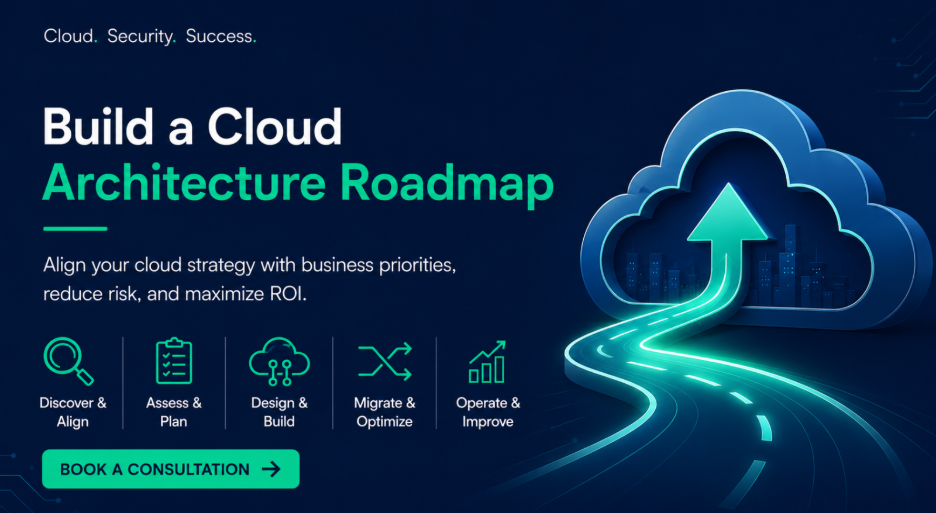
There is not one correct method, but most successful programmes move through five stages.
Stage 1: Discovery and business alignment
Start with the business, and not the servers. Interview leaders across finance, product, and operations. Capture what a good result looks like in plain language. Faster product launches? Lower recovery time after an incident? Simpler audits? Write it down and get a sign-off.
Stage 2: Current state assessment
Map your current applications, data flows, dependencies, and infrastructure to spend. Use application discovery tools to avoid speculation. This is the stage where business priorities and technical readiness shape the migration sequence.
Stage 3: Target architecture design
Now design the future state. This covers cloud infrastructure design, network topology, identity model, cloud security architecture, and the shared services your platform teams will run. Pick reference architectures where they exist. Reinventing the wheel is expensive.
Stage 4: Migration sequencing
Build the cloud migration roadmap. Group applications into waves based on complexity, business risk, and shared dependencies. Assign owners, dates, and success criteria to each wave. Leave room for a stabilisation period between waves.
Stage 5: Operate and improve
The roadmap does not end at go-live. Define how your cloud operating model will modify, how FinOps will track spend, and how you will set yourself free from your old systems. Set a quarterly review to adjust priorities.
How do you choose the right cloud architecture for your business?
The appropriate choice depends on four factors. These factors involve data sensitivity, latency needs, regulatory scope, and internal skills. The comparison below can guide the conversation with your team.
UK financial services firms often adopt hybrid cloud models due to PRA and FCA operational resilience expectations. Retailers mostly pick multi-cloud to keep supplier options open. Choose the model that fits your regulator, your customers, and the team you can actually hire.
Enterprise cloud architecture best practices
A few habits separate the programmes that deliver from the ones that delay.
Design for cloud governance from day one. Building governance and cost controls early is simpler and more cost-effective than fixing them later.
Build cloud security as an ongoing capability. Standing security teams, backed by automated controls, catch drift before auditors do.
Keep your target operating model small. A well-designed platform enables a small engineering team to support multiple application teams.
Measure what matters. Track key operational and cost metrics to measure the success of your cloud strategy. Uptime alone will not.
Publish the roadmap. Teams that can see the plan make better local decisions. A cloud transformation strategy locked inside a leadership deck helps no one.
When to bring in a specialist partner?
Many organisations lack the internal capabilities to deliver large-scale cloud programmes. Independent cloud architecture consulting services can shorten the discovery phase, challenge assumptions, and bring reference structures from similar sectors. When selecting a partner for enterprise cloud consulting or cloud migration consulting, ask for named case studies in your industry and the exit criteria they will write into the contract. ACME One partners with UK and MENA organisations to design and implement enterprise cloud architectures.
Common pitfalls to avoid
Lifting and shifting everything:
Some workloads should stay where they are. Some should retire. Blanket migration raises the cost and adds risk.
Skipping the FinOps conversation:
Without unit economics, cloud looks expensive within six months.
Underinvesting in identity:
Identity is the foundation of cloud security, making a strong identity model essential for every other security control.
Forgetting humans:
Most cloud programmes fail on change management, so it is crucial to fund a training and communications plan.
Closing thoughts
A well-planned cloud architecture roadmap balances immediate priorities with long-term business goals. It provides timely guidance, keeps stakeholders aligned, and gives teams a clear path forward.
The greatest cloud value comes from strategy, not flashy technology. They succeed with a roadmap aligned across business and IT. As priorities change, the roadmap keeps teams aligned. That matters more than any tool or vendor.
Start small if you need to. Focus on delivering a realistic roadmap today rather than creating a perfect plan for the next three years. Get it in front of your teams, listen to the questions they raise, and refine it.