Data volumes keep climbing. IDC estimated that global data volumes would grow to about 181 zettabytes by 2025. Global data volumes continue to grow at a rapid pace. Many US enterprises still depend on outdated reporting processes that are difficult to maintain.
This gap has made data platform engineering a business priority. Reliable data infrastructure is essential for customer insights, real-time risk, and AI.
This guide covers data engineering, scalable platforms, partner selection, and typical costs.
Why do businesses need data platform engineering services?
Most companies don’t have a data problem. They have a plumbing problem. Data sits in CRMs, billing systems, product logs, warehouses, and third-party APIs. Analysts stitch it together by hand. Reports take days. Trust erodes.
Data platform engineering services for enterprises fix that at the source. They design the pipelines, storage layers, and governance that let data flow from origin to insight without human hand-holding.
A few common signs a business needs help:
- Reports pulled from different systems don’t match.
- Data science projects stall because clean data isn’t available.
- Cloud data bills grow faster than usage justifies.
- Audits turn up gaps in access controls or lineage.
- Adding a new source takes weeks instead of hours.
Many US enterprises still rely on fragile reporting systems. Enterprise data engineering services close that readiness gap.
What modern data architecture looks like today?
Modern data architecture has moved past the single warehouse model. Today’s designs blend several layers:
Ingestion:
Data pipelines that collect information from business systems, SaaS tools, and live data sources.
Storage:
A lakehouse combines low-cost storage with fast, reliable data analysis.
Transformation:
SQL and code-based models managed like software, with version control and CI.
Serving:
Feature stores, semantic layers, and APIs that expose data to BI tools, applications, and ML models.
Governance:
Catalogs, lineage, access policies, and quality checks that sit across every layer.
Enterprise data architecture also has to plan for cost. A well-designed platform matches compute to workload, so an ad hoc analyst query doesn’t spin up the same resources as a nightly aggregation.
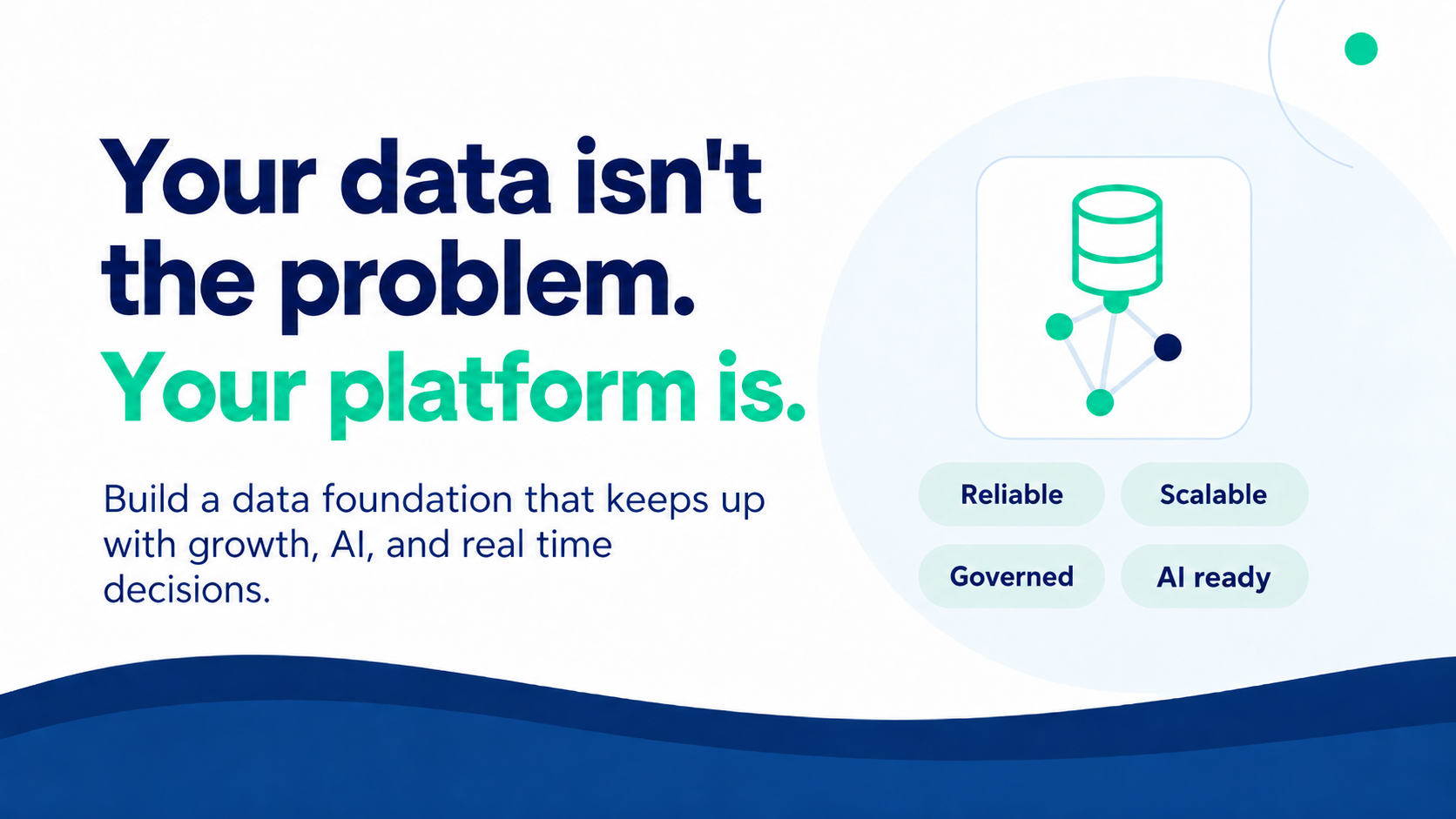
Core capabilities of enterprise data platforms
Strong data platform development covers a set of core capabilities. Miss any of them, and the whole system gets shaky.
Reliable ingestion:
Data lands on time, in the expected shape, with clear failure alerts.
Reusable transformations:
Business logic lives in versioned models, not tribal knowledge.
Observability:
Freshness, volume, schema, and quality get monitored the way apps do.
Data governance:
Ownership, classification, access, and retention are defined and enforced.
Cost visibility:
Teams see the price of the queries and pipelines they run.
Security and privacy:
Controls align with HIPAA, PCI DSS, CCPA, and NIST frameworks where they apply.
Reliable data infrastructure is what turns a data lake into a data platform. Without governance and observability, a lake is just a swamp.
How can data platforms support business growth?
Growth-ready systems free the business to move faster. Here’s how that shows up in practice:
Faster launches:
New data-driven features launch without custom pipelines.
Better decisions:
Executives get numbers they trust, closer to real time.
AI that ships:
Clean data helps machine learning models reach production faster.
Lower unit costs:
Consolidated storage and smarter compute cut waste as volumes grow.
Easier acquisitions:
Absorbing a new company’s data turns into a project instead of a nightmare.
McKinsey links strong data practices with faster decisions and higher revenue growth.
Comparison table: three approaches to enterprise data platforms
The table below compares three common approaches US enterprises take when building data infrastructure. Figures are illustrative and vary by scope.
| Approach | Time to first value | Typical annual cost | Governance maturity | Best fit |
| In-house build from scratch | 12 to 24 months | $2M and up | Depends on hires | Large firms with mature engineering benches |
| Off-the-shelf SaaS only | 1 to 3 months | $150K to $1M+ | Vendor defined | Simple use cases, small teams |
| Custom data platform services with a partner | 3 to 9 months | $250K to $2M | High, if scoped in | Mid-market to enterprise needing fit and control |
Custom data platforms give growing US businesses greater control and room to scale. Data platform consulting services help scope the right blend for each business.
Data platform modernization: what a good program looks like?
Data platform modernization doesn’t require replacing everything at once. The migration happens in stages while daily operations continue.
A typical program runs in four phases:
Discovery:
Review data sources, priorities, service needs, and key gaps. Identify major issues and quick wins.
Foundation:
Stand up the Lakehouse, ingestion framework, governance model, and CI/CD.
Migration:
Move workloads in priority order, retire legacy jobs, validate parity.
Optimization:
Tune cost, performance, and reliability once workloads stabilize.
Each phase should end with a working system, and not a slide deck. That’s how enterprise data platform development services stay accountable.
How much do data platform engineering services cost?
Cost depends on three things: scope, complexity, and speed. A rough guide for US enterprise programs:
Assessment and roadmap:
$25K to $75K, four to eight weeks.
Foundation build:
$150K to $500K, three to six months.
Full modernization program:
$500K to $3M or more over a year or longer.
Ongoing platform operations:
$30K to $150K per month depending on scale.
Cloud bills sit on top of service fees. Well-designed platforms can pay back within 18 to 24 months through lower costs and faster delivery.
What to look for in a data platform partner?
Not every firm that sells data engineering can deliver at enterprise scale. Ask for:
- Reference architectures they’ve actually shipped, not just diagrams.
- Named engineers on the account, with resumes.
- A clear position on governance, security, and lineage from day one.
- A fixed scope discovery phase, so you can test fit before signing a long deal.
- Willingness to work alongside your internal team, not around it.
Firms like ACME One build custom data platforms for regulated and growth-stage enterprises, with in-house teams across data engineering, ML, and DevOps.
Common pitfalls to avoid
Even good teams stumble. The most frequent misses:
- Building the warehouse before defining the governance model.
- Copying every legacy job instead of retiring what nobody uses.
- Skipping observability until something breaks in production.
- Underestimating the change management side of data ownership.
- Picking tools before writing down the use cases.
Modern data platform engineering solutions address these upfront, not after go-live.
Conclusion
Data platform engineering is the difference between a business that reacts and a business that anticipates. Data platform engineering gives US enterprises reliable pipelines and strong governance. It also supports growth without frequent rebuilds. Start with a strong data foundation, whether through assessment or modernization. It will support future analytics, AI, and product growth.