Qatar’s workforce is changing fast. Qatar National Vision 2030 and the digital agenda are reshaping workforce development. Employers across Qatar are rethinking training, upskilling, and retention. One technology keeps coming up in that conversation, and that is virtual reality.
Virtual reality is now a practical business tool. Virtual reality solutions now support training in hospitals, energy, logistics, and corporate learning. VR can speed training, improve safety, and build employee confidence. This guide shows how VR boosts workforce productivity in Qatar.
Why Qatar’s Workforce Is Ready for Virtual Reality?
Qatar’s employers face a common set of pressures. Skilled labor is in high demand, while project timelines remain tight. Qatar’s labor framework also leaves little room for safety errors. Healthcare, energy, finance, and logistics face growing productivity demands. These sectors are key priorities under Qatar’s Third National Development Strategy.
This is where VR workforce solutions earn their keep. Employees can practice in VR without leaving the job for long classroom sessions. Employers can then track and measure their performance. The training happens where the work happens, and the data comes back clean.
How Is VR Used in Employee Training?
Modern workforce training technology treats learning as practice, not lectures. VR simulation places employees in realistic scenarios and tracks their decisions. Common patterns across enterprise VR solutions include:
- Procedural drills for equipment operation, from field service to plant maintenance.
- Soft skills rehearsal such as difficult conversations, coaching, and customer complaints.
- Compliance simulations that train staff to report hazards and handle data correctly.
- VR onboarding tours help new hires learn the facility before day one.
- Remote VR training connects teams across multiple locations.
PwC found VR learners completed training up to four times faster. They were also 275 percent more confident applying what they learned. Verify these figures against PwC’s latest publication before citing them. The broader finding is clear, which is that immersive practice improves learning retention.
How Do Virtual Reality Solutions Improve Workforce Productivity?
Productivity gains from VR do not come from the headset itself. They come from three underlying shifts in how work gets learned and done.
Faster time to Competency
New staff reaches full performance sooner. VR simulation speeds up training and reduces ramp-up time. For hospitals, faster nurse onboarding can improve patient throughput.
Fewer Costly Mistakes
Errors made in a virtual environment cost nothing. Errors made on a live production line, a trading desk, or a patient bed cost a great deal. Enterprise VR lets employees practice safely until the right response becomes automatic.
Better Retention of what was Learned
Immersive learning is remembered longer. University of Maryland research found VR improved information recall. Participants remembered VR content better than material shown on a flat screen. Combined with spaced repetition, this raises the ceiling on what a workforce can master in a year.
Together, these gains improve productivity across healthcare, manufacturing, and back office operations. This is why VR skill development has moved from pilots to permanent programs.
Benefits of VR Solutions for Businesses in Qatar
- Shorter onboarding, which frees senior staff from repetitive training duty.
- Consistent quality of training across every branch, city, and shift.
- Measurable performance data on every learner, exportable into existing HR systems.
- Lower travel and venue costs, which matter for firms operating across the GCC.
- Digital training tools can make employers more attractive to Qatari graduates.
- Reduced risk of incidents in high-hazard environments such as construction and energy.
How Does Virtual Reality Improve Workplace Safety?
Qatar safety programs face strict regulatory oversight. The challenge is that safety training only works if people take it seriously and actually practice the correct response.
Virtual reality fixes both problems. Workers can practice high-risk scenarios safely in VR. They practice evacuation, shutdown, and reporting until the response becomes automatic. Industrial safety studies report up to 43 percent fewer recordable incidents. The improvement followed a shift from slideshow training to VR safety drills. The figure varies by sector and should be verified with the cited source. Still, repeated safe practice is more effective than a single exposure.
For Qatar’s construction and energy sectors, this reduces risk and stoppages. It also strengthens evidence of duty of care during audits.
How Is Virtual Reality Used in Healthcare Training?
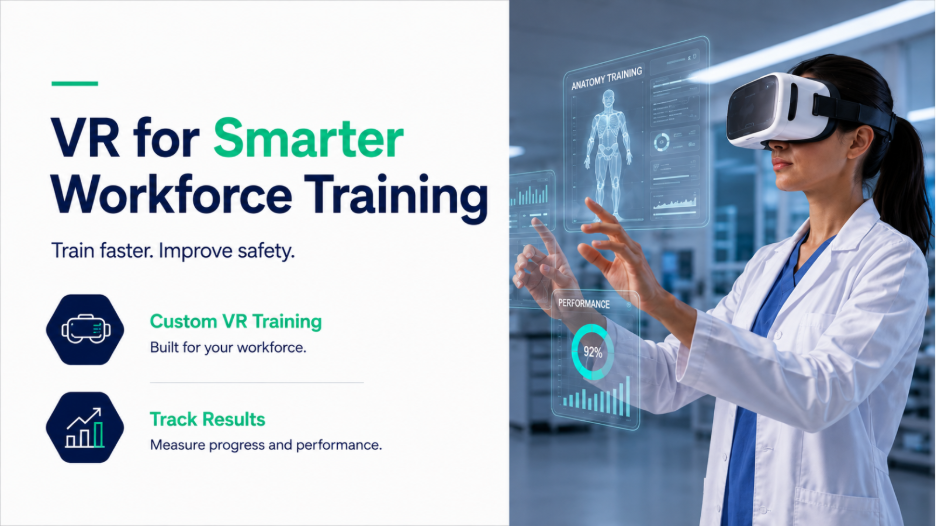
Healthcare VR is the sector where the productivity case is easiest to make. Clinical staff need constant practice, patients cannot be used as training material, and cadaver labs are limited. Virtual clinical environments solve all three constraints at once.
Common applications of virtual reality in healthcare training include:
- Surgical simulation training for laparoscopic, orthopedic, and cardiac procedures.
- Medical simulation for emergency response, triage, and code blue scenarios.
- Anatomy and diagnostics tutorials for medical students and residents.
- Communication practice for breaking difficult news to patients and families.
- Virtual reality simulations for hospital staff running through infection control drills.
A Journal of Bone and Joint Surgery study found VR-trained residents performed procedures 20 percent faster. They also completed 38 percent more steps correctly than conventionally trained peers. Again, verify against the current source before publication.
Qatar’s growing hospital network can use custom VR to standardize training across sites. It also reduces the time clinicians spend away from patient care. VR is now part of healthcare workforce training procurement. It increasingly complements or replaces physical simulators.
Traditional Training vs VR Simulation Training
The table compares conventional training with VR simulation training. It focuses on the factors Qatar procurement teams value most.
| Training Factor | Traditional Methods | VR Simulation Training |
| Time to competency | Several weeks of classroom and shadowing | Up to four times faster per PwC study |
| Learner confidence | Varies with instructor and setting | 275 percent more confident to act on training |
| Emotional connection | Moderate, depends on facilitator | 3.75 times more emotionally connected to content |
| Cost per learner at scale | Rises with travel, venues, and instructor time | Falls sharply once 375 or more learners are trained |
| Safety risk during practice | Live equipment, real patients, real hazards | Zero physical risk in virtual clinical environments |
| Repeatability | Limited by schedules and resources | Unlimited practice on demand |
The table uses findings from PwC, safety bodies, and healthcare journals. Verify all figures against the latest sources before external use.
Transform Health Recovery with ACME One Virtual Reality Solutions
Rehabilitation is one of the most promising and least discussed uses of VR in healthcare. VR can support stroke recovery, mobility, pain management, and cognitive therapy. Immersive practice can also make rehabilitation more engaging for patients.
ACME One combines VR development with clinical expertise. The team supports healthcare providers across Qatar and the wider GCC. The work covers assessments, therapist dashboards, and gamified patient exercises. It also integrates with existing hospital information systems. Therapists can adjust difficulty and track movement data in real time. They can also share patient progress without extra paperwork. VR can support both healthcare workforce training and patient recovery. The same platform can train therapists while supporting patient care.
Hospital directors need VR platforms that protect patient data and fit clinical workflows. They should also scale as healthcare services grow. These questions should come before any headset purchase.
Closing Thoughts
Virtual reality solutions are gaining boardroom attention for their clear productivity value. For Qatar employers, VR is no longer a risky training investment. It shortens training, improves safety, and strengthens clinical practice. It also gives leaders clear data on employee learning and performance.