UK boards are under pressure to modernise. Costs are rising, talent is tight, and customers expect the kind of digital experience that only fits purpose systems can deliver. That puts one question on every leadership agenda, and that is should the business buy a packaged product, or invest in custom software development for enterprise needs? This guide compares the main approaches, explains what changes at measurement, and helps you decide which route fits your operating model.
What is enterprise custom software development?
Enterprise custom software development creates software built for a single organisation. The software is built around your processes, users, data, and compliance needs. It includes everything from customer portals to enterprise supply chain platforms.
The output is more than the code. It includes structure, security, integration, and ongoing support. This is how tailored, automated, and AI-powered business software is delivered.
Why are UK enterprises revisiting the build vs buy question?
The market has shifted. Gartner forecast worldwide IT spending to pass 5.6 trillion US dollars in 2025, with software the fastest growing category at more than 14 percent year on year. Enterprise applications alone are a big part of that, and much of the growth is going to replace deteriorating systems that no longer support the way UK businesses operate.
Two forces sit behind the shift. Packaged software rarely fits complex, regulated enterprise workflows. Cloud platforms have made custom development faster and cheaper. What used to be a two-year programme can now ship its first release in a quarter.
Custom software vs off the shelf software: a side-by-side view
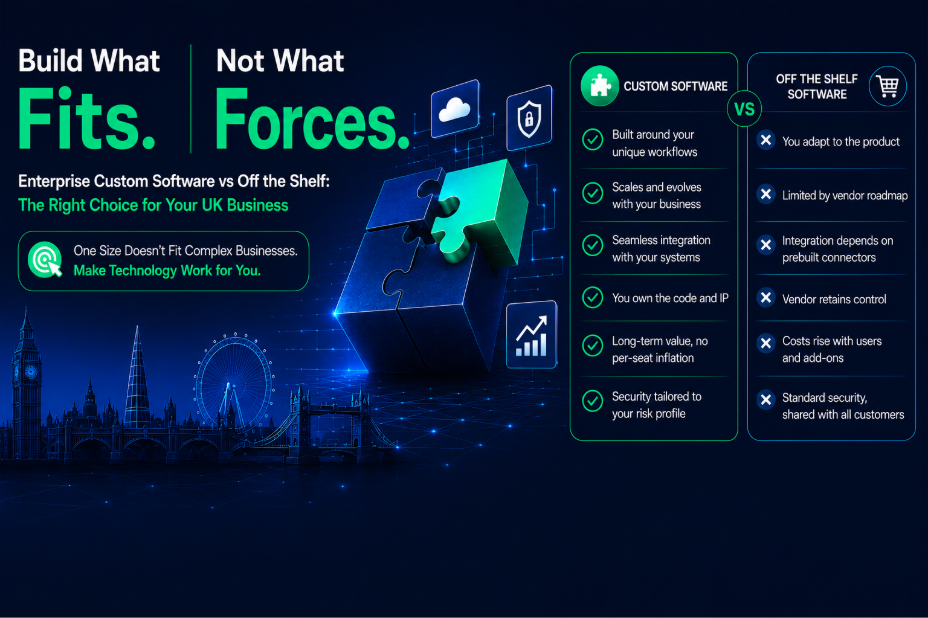
Before choosing an approach, it helps to see the tradeoffs on a single page. The table below compares custom software with off the shelf software across the factors UK leaders raise most often.
| Factor | Custom Software | Off the Shelf Software |
| Upfront cost | Higher initial investment | Lower entry cost, licence fees ongoing |
| Time to launch | Weeks to months, phased releases | Days to weeks after procurement |
| Fit to workflow | Built around your processes | You adapt to the product |
| Scalability | Grows with the business | Capped by vendor roadmap |
| Integration | Direct fit with ERP, CRM and legacy systems | Depends on prebuilt connectors |
| Ownership | You own the code and IP | Vendor retains control |
| Long term cost | Predictable, no per-seat inflation | Rises with users and add-ons |
| Security controls | Tailored to your risk profile | Standard, shared with all customers |
Neither column is right for every job. A finance team can buy a strong general ledger and never regret it. A logistics operator running a bespoke fleet model will struggle to force that model into a packaged product. The trick is matching the approach to the work.
The four main approaches to enterprise custom software development
In-house build
You hire and run the engineering team. This gives full control over the plan, deep product knowledge inside the business, and direct accountability. It also means carrying the recruitment burden in a market where UK tech vacancies remain high. Modern platforms have made custom software more affordable.
Outsourced delivery with a Tailored Software Solutions Provider for Enterprises
A partner brings a delivery team, engineering leadership, and an established way of working. This suits programmes where you need pace, a broad skill mix, or capacity you cannot recruit on your own timeline. Reduce risk with documentation, handover, and knowledge transfer.
Hybrid model
Most large UK programmes end up here. Product ownership, structure and a small core engineering group stay in-house. Custom enterprise application developers from a partner measure delivery up or down as the plan demands. This model gives you speed without losing control of intellectual property.
Low code and configuration on packaged platforms
For simpler workflows, teams can build on top of platforms that are already in use. This is faster than a custom-built but quickly reaches the top based on performance, combination, and unique logic. Treat it as a strategic choice and not a strategic one.
Where does custom software earn its cost?
Custom software delivers value when your tasks are authentic or properly regulated. It also pays off when transaction volumes make licencing too expensive. Any of these tips are math in favour of a build.
The World Economic Forum’s Future of Jobs report has repeatedly ranked technology adoption as the leading driver of business transformation with employers expecting most workers to need reskilling by 2030. That reskilling is far easier when the software matches how people actually work, which is exactly what business software development delivers.
Digital transformation services and legacy system modernisation
Most UK enterprises are not starting from a blank sheet. Most enterprises rely on legacy systems, ERP, CRM, and disorganised data. Digital transformation modernizes legacy systems without disrupting business.
A good programme starts with an honest audit. Which systems still earn their keep? Which ones can be wrapped with APIs and left running? Which ones must go? From there, an enterprise software development plan sequences the work, so users see improvements early, and the risky pieces get the most attention.
Can custom software integrate with existing ERP and CRM systems?
Integration should be treated as a first-class part of the design. Most enterprise ERP and CRM platforms reveal REST or SOAP APIs, event streams, and database connectors. A custom application sits alongside them, reads and writes the records it needs, and adds the logic the packaged system does not cover.
The common failure mode is pointed out integration that grows into a tangle. An integration layer connects systems and simplifies future upgrades.
What industries benefit most from enterprise custom software?
Any sector with complex, regulated or high-volume workflows tends to see a great return. In UK practice that includes:
- Financial services and insurance, where risk models, regulatory reporting and claims handling rarely match packaged products.
- Healthcare and life sciences, where patient pathways, NHS integration and data protection under UK GDPR need bespoke controls.
- Retail and consumer goods, where customer experience, loyalty and supply chain are direct competitive levers.
- Energy and utilities, where asset management, field operations and grid data need real time integration.
- Public sector and central government, where citizen services, accessibility and data sharing sit under GOV.UK service standards.
- Logistics and manufacturing, where scheduling, telemetry and workflow automation software drive margin.
How much does enterprise custom software development cost?
There is no single figure. Cost depends on scope, integration count, regulatory load, user volume and the engineering standard you set. As a rough guide for UK programmes, a focused enterprise application with two or three integrations typically sits in the low to mid six figures for the first release, with ongoing product and platform costs after that. Complex, multi-region platforms run into seven figures.
The most authentic number is the total cost of ownership over five years. This includes licences avoided, productivity gained, incidents prevented, and the value of owning the strategy. When teams model it that way, the case for a build often looks stronger than the sticker price suggests.
Choosing an enterprise software solutions provider
Whether you build in-house, outsource or run a hybrid, the choice of partner shapes the outcome. Look for industry experience, strong engineering, proven security, and a collaborative approach. ACME One is an example of a provider working with UK and international enterprises on custom builds, cloud engineering and modernisation programmes of this kind.
Ask for references, code samples, and a paid discovery before committing. The best providers welcome that scrutiny.
A practical way to decide
If you are still measuring the options, the decision usually comes down to five questions. These questions include: Is this workflow a source of competitive advantage? Do packaged products force compromises your users will feel every day? Will licence and change costs outstrip a build within five years? Does regulation demand controls you cannot get off the shelf? Do you have, or can you assemble, the product ownership to run a build well?
If you answer yes to three or more questions, enterprise custom software development services are likely the right route. If you answer yes to fewer, a packaged product with light configuration will probably deliver value faster.
Closing thoughts
The build vs buy question is not really about software. It is about how much control you want over the way your business runs. Off the shelf software is a sensible choice for commodity work. For the systems that define your service, your margin and your risk, custom software development for enterprise programmes give you an asset you own and can shape over time. Get the mix right and the technology stops being a constraint on the business and starts being a source of advantage.