Every organization hits these crossroads at some point. You need a healthy digital transformation roadmap, but you’re not sure who should build it. Do you hire internally, train your current team, or bring in outside expertise?
The answer isn’t obvious, and the wrong choice doesn’t just cost money. It costs time, momentum, and some organizational trust.
Let’s break it down honestly.
What Does a Digital Transformation Roadmap Actually Do?
A business transformation roadmap plan is an organized document that connects your current state to a future vision, maps the steps to get there, and assigns ownership to every major milestone.
Done well, it corresponds to leadership, guides technology decisions, and keeps your teams from working in silos. If done poorly, it becomes a pitch deck that nobody looks at after the initial meeting.
The quality of your plan depends mainly on who builds it and how.
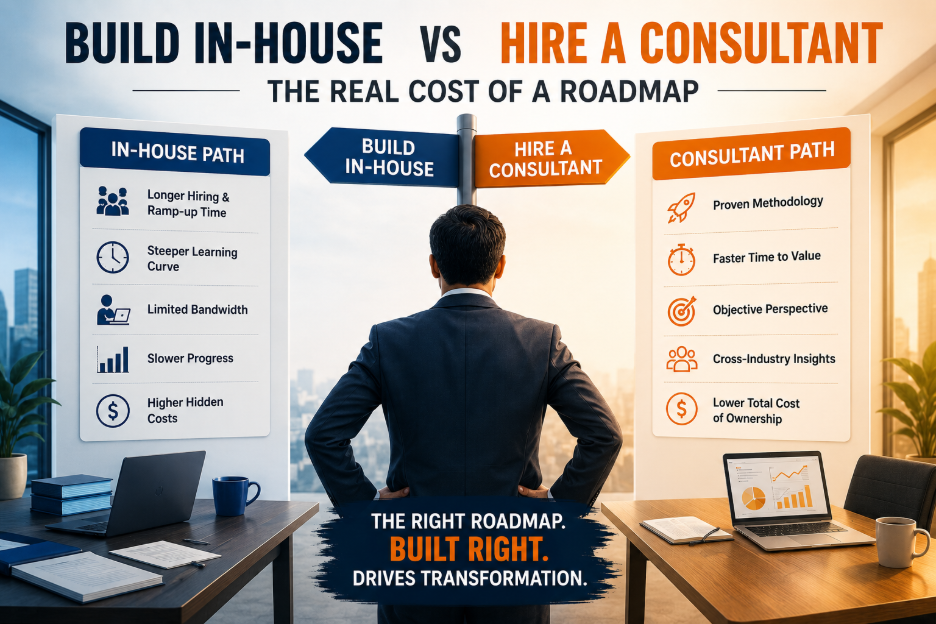
The In-House Path: What You’re Really Signing Up For
Building an in-house roadmap team sounds attractive. You keep in control. You build internal capability. You avoid consultant fees.
But the true cost is often underestimated.
Hiring and onboarding a senior strategist with enterprise planning experience takes a minimum of three to six months. Salaries for this kind of talent in the USA, UAE, and UK markets run from $90K to $160K per year, not counting benefits, tools, and management overhead.
The learning curve is real. Your internal team knows your business well, even though there is a specific technique required for strategic roadmap planning at the enterprise level. Most organizations don’t have that capability built yet.
Bandwidth becomes a problem. Internal teams carry out existing responsibilities. Roadmap work competes with regular tasks, and progress slows down.
In-house path makes sense, you’re planning for the long term and want to build real internal capability over two to three years. But if you need a working roadmap in the next two quarters, this route often stalls.
Real-World Scenario: The In-House Attempt That Stalled
A medium-sized distribution company in the UK decided to build its digital transformation roadmap internally. They had a capable IT director and a small project management team. Leadership felt confident.
Six months in, they had a 40-slide deck and no agreed-upon priority list. Three departments had submitted contradictory demands. The IT director was spending 70 percent of his time in alignment meetings instead of doing the actual planning work.
By month nine, the board requested an external review. A consultant came in, ran a structured discovery process across four weeks, and produced a working plan in ten weeks. The internal team’s work wasn’t wasted, but the delay had cost them an entire product cycle.
This isn’t unusual. It’s actually one of the most common patterns in enterprise digital strategy planning services.
Hiring a Consultant: What You Actually Get
A skilled digital transformation consultant brings three things you can’t easily duplicate internally, which involve methodology, speed, and cross-industry pattern recognition.
They’ve seen what works across various similar engagements: They know the failure points before you hit them. These experts come in with a framework that doesn’t require six months of setup.
Speed is the biggest advantage: A consultant with proven roadmap development services can deliver a strategic plan in eight to twelve weeks. Internal teams tackling the same scope typically take six to nine months.
Objectivity matters, too: An outside consultant can say the hard things. Internal teams sometimes avoid surfacing uncomfortable findings because of internal politics. Consultants don’t have that problem.
The cost is more visible but often lower in total: A mid-range consulting engagement for enterprise roadmap planning runs between $40K and $120K depending on scope and market. Compare that to two years of full-time salary, and the math shifts quickly.
That said, not all consulting is equal: Firms that offer templated deliverables with minimal customization won’t move the needle. You want a partner who builds alongside your team, not just for them.
Real-World Scenario: When Consulting Got It Right
A financial services firm in the UAE was under pressure to modernize its customer-facing systems. Leadership had been debating direction internally for over a year with no consensus.
They brought in a roadmap consulting team for a twelve-week engagement. Consultants aligned key stakeholders early, identified three conflicting priorities, and removed major roadblocks.
The result: a board-approved digital transformation roadmap delivered in eleven weeks. Implementation started in the following quarter. The internal team, which had been stuck in debate for twelve months, was now executing clarity.
The difference wasn’t intelligence or effort. It was structured and from an outside perspective.
Real-World Scenario: The Hybrid Approach That Worked Best
A retail enterprise in the USA had already run one successful roadmap cycle with an external consultant two years prior. Their internal team had absorbed the methodology, understood the process, and wanted to lead the next cycle themselves.
They brought the consultant back in a reduced capacity, two weeks of structured workshops, and a final review, rather than a full engagement. The internal team did the bulk of the work. The consultant provided the framework checkpoints and challenged assumptions at key stages.
The total cost was 30 percent of the original engagement. The roadmap was delivered on time and with stronger internal ownership than the first cycle.
This is the model most mature organizations eventually land on. Start with full consulting support. Build internal capability along the way. Reduce external dependency over time without losing the methodology that made the first roadmap work.
The Hidden Cost Nobody Talks About
Whether you build in-house or hire a consultant, the highest cost isn’t financial. It’s the cost of delay. Every month you spend debating this decision or running a roadmap process that stalls is a month your competitors are executing. In industries undergoing active digital transformation, that gap compounds fast.
Organizations that work with a partner like ACME One on their digital transformation roadmap consistently cut planning timelines by 40 to 60 percent compared to purely internal efforts. The goal of technology roadmap consulting isn’t to replace your team’s thinking. It’s to accelerate it.
How to Actually Decide?
Here’s a simple framework:
Hire a consultant if:
- You need a plan within the next two to three quarters
- Your internal team lacks experience in enterprise planning.
- You need cross-functional alignment across business units.
- You’ve tried internal roadmap efforts that have stalled before.
Build in-house if:
- You have a multi-year transformation program and time to invest in capability.
- You’ve already run successful roadmap cycles internally.
- You have senior talent with direct experience in strategic roadmap planning.
- Ongoing internal ownership is a core strategic priority.
Most organizations benefit from a hybrid approach: bring in roadmap consulting expertise for the first engagement, then transfer the methodology to internal teams for ongoing cycles.
Final Remarks
In conclusion, building a digital transformation roadmap is one of the most consequential planning decisions an enterprise can make. Get it right, and you have a clear, shared direction that your teams can actually execute against. Get it wrong, and you end up with a document that collects dust while your organization continues operating without a real strategy.
The build vs hire debate often distracts from the real question, which is whether we are moving fast enough. Internal capability is worth investing in. It takes time to develop, and time has a cost. Consultants aren’t a shortcut to thinking; rather, they have a way to compress the timeline between insight and execution. The most successful organizations don’t permanently choose one or the other. They start with external expertise to build the first plan properly, then internalize that methodology over time. That’s how you get both speed now and capability later.
Whatever path you choose, the worst option is waiting. The competitive landscape in digital transformation doesn’t pause internal debates.