
The Kingdom’s software market is heating up. Saudi Arabia’s cloud spending is projected to cross USD 2.5 billion by 2026, according to IDC figures cited in regional trade reporting. Saudi enterprises need SaaS platforms built for scale, security, and growth.
That’s where SaaS product development comes in. This guide explains SaaS development, costs, and how to choose the right development partner.
What is SaaS product development?
SaaS product development is the process of building and maintaining subscription-based cloud software. A SaaS product is a living asset. You keep shipping updates, adding features, patching security holes, and reading usage data.
It covers the full lifecycle, from discovery and design to development, testing, launch, and support. A solid SaaS product roadmap ties all of this to business outcomes and not just feature lists. Good SaaS application development treats the plan as a living document; that is reviewed every quarter.
Most modern SaaS platform development runs on public clouds. AWS is the top choice for MENA SaaS teams, offering Bahrain hosting and PDPL friendly data residency. Microsoft Azure and Google Cloud have their supporters too, especially teams who have already invested in those ecosystems.
The SaaS product lifecycle in plain terms
Every SaaS project moves through five stages.
Discovery:
Define the problem, the buyer, and the metrics that matter. Skip this and you’ll rebuild in year two.
Design and architecture:
Multi-tenant vs single-tenant. Monolith vs microservices. Data isolation model. These choices lock in for years.
MVP build:
Ship the smallest thing that proves the product works. Six to nine months is a realistic window for a mid-scope B2B tool.
Launch and iterate:
Early customers break assumptions. Fix fast and keep a tight feedback loop.
Scale:
Now you worry about tenant load, cost per user, uptime SLAs, and revenue expansion.
SaaS product development cost: real numbers
Let’s talk about money. SaaS product development pricing varies widely, but here’s a realistic picture based on Clutch, GoodFirms, and vendor rate cards published across 2024 and 2025.
- Simple MVP (single tenant, basic dashboards, one integration): USD 40,000 to USD 80,000.
- Mid-scope B2B SaaS (multi-tenant, role-based access, three to five integrations, mobile responsive): USD 90,000 to USD 250,000.
- Enterprise SaaS platform (complex workflows, high compliance, AI features, deep integrations): USD 300,000 to USD 750,000 and up.
For Saudi buyers, add roughly 10 to 20 percent when Arabic-first UX, local hosting, and PDPL compliance work are in scope. These aren’t optional line items in most enterprise Saas product development services here.
Ongoing costs matter more than most founders expect. You must plan 15 to 25 percent of the build cost per year in cloud, licensing, and engineering support. Statista put average enterprise SaaS spend per employee at around USD 8,700 in 2024, which tells you buyers are willing to pay when the product delivers real value.
SaaS product development best practices
A few habits separate SaaS products that measure from the ones that stall.
Design for multi-tenancy from day one
Upgrading tenant isolation later is painful and expensive. Get the data model right early, choose between pool and silo models with your compliance team in the room, and document the decision.
Instrument everything
Product analytics, error tracking, and cost dashboards should ship with your first release. You cannot improve what you can’t see. Tenant-level metrics matter more than the total ones.
Automate deploys
CI/CD, infrastructure code, and blue-green releases stop being optional once paying customers arrive. Manual deployments turn into weekend incidents.
Build security in, not on
SaaS security failures kill deals in the GCC. Encrypt at rest and in transit, enforce SSO, run regular penetration tests, and align with ISO 27001 and NCA ECC controls. Buyers ask for evidence and not promises.
Write a real SaaS product roadmap
Tie every quarter to a customer outcome. Retention, expansion revenue, activation rate. Not just shipped 12 features. Strategies built around outcomes attract better investors and better hires.
SaaS development challenges in the region
MENA teams hit a specific set of walls. Talent supply for senior SaaS engineers is tight, especially those with production experience in multi-tenant AWS SaaS development. Arabic and English bilingual UX adds design and QA cost. PDPL and sector rules from SAMA and CST require documented controls that many offshore vendors don’t handle out of the box.
Then there’s the buyer side. Saudi enterprises still expect a real human relationship, on-ground support, and clear escalation paths. A SaaS vendor with only a Slack channel and a Delaware address rarely closes seven-figure deals here. Presence matters, and so does patience during procurement.
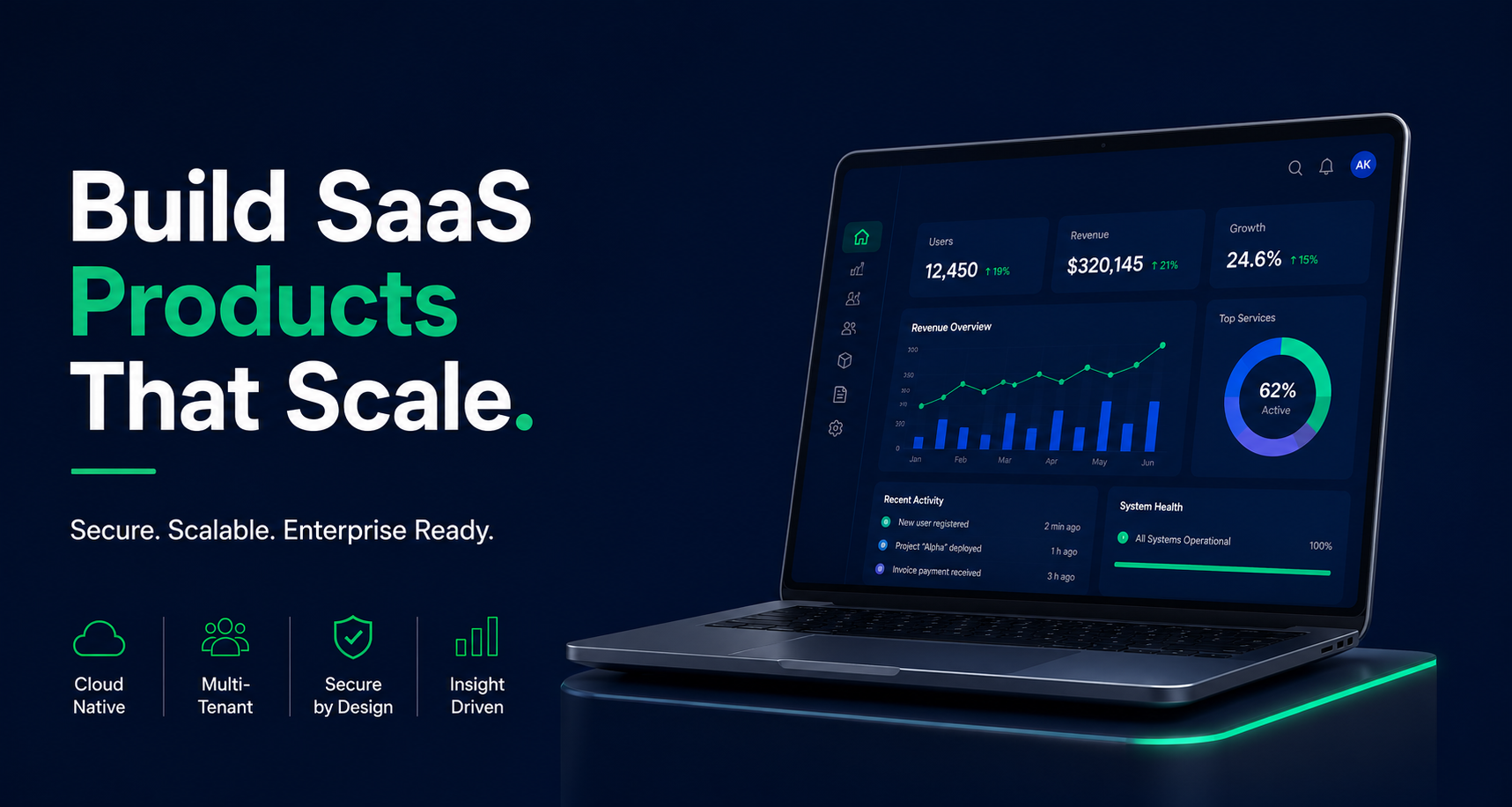
How do SaaS companies scale their products?
Measuring isn’t just adding servers. Teams that get it right treat the measurement process as a design problem. They separate compute from storage, pre-fetch, and move heavy jobs off the request path. They watch cost per active tenant weekly, not quarterly. They ship risky changes behind feature flags to five percent of users first, then widen the rollout.
Enterprise SaaS teams build these in from day one. If observability or capacity planning is missing, treat it as a red flag.
Choosing a SaaS development partner
When you evaluate SaaS development solutions, vendors ask hard questions and don’t settle for polished slides.
- Show me two multi-tenant SaaS products you built that are still in production.
- Who owns the code, the repos, and the cloud accounts at the end of the engagement?
- What’s your incident response process, and what’s your average time to restore?
- How do you handle PDPL, data residency, and cross-border data flows?
Vendors that pass this filter tend to be worth the premium. Cheap SaaS software work often becomes expensive for rework, and rework in year two burns through the runway you were counting on for growth.
One partner worth knowing about for the KSA and wider MENA market is ACME One, which delivers SaaS platform development, cloud infrastructure, and application modernization for enterprise buyers across the region. Whatever partner you choose, apply the same checklist and don’t sign until the answers are in writing.
Concluding remarks
SaaS product development is a long game. The teams that win in Saudi Arabia and the wider GCC do not always have the biggest budgets. They’re the ones that pick up the right architecture early, respect PDPL and local buyer expectations, and treat the product plan as a business tool and not a wish list.
If you’re planning your next move, start small. Run a two-week discovery. Test your multi-tenant model, track early KPIs, and prioritize speed, security, and value.
The Saudi market rewards operators who show up prepared. Get the basics right, and the growth follows.