Whether you’re building a business tool, customer portal, or SaaS product, cost is usually the first concern. How much does custom web app development cost in the USA in 2026? The honest answer is that it depends. This guide covers real costs, key factors, and ways to control spending.
The US remains one of the most expensive and competitive markets for software development.
The US Web App Market at a Glance
Demand for custom web applications keeps climbing.
A few figures worth knowing before you start budgeting:
- Senior US web app developers typically charge $120 to $250 per hour.
- Small business web apps typically cost $25,000 to $75,000.
- Mid-market platforms usually run $80,000 to $250,000.
- Enterprise-grade systems can easily cross $500,000 and keep climbing.
These are ballpark ranges. Final costs are based on scope, integrations, compliance, and your development team.
What Custom Web Application Development Actually Includes?
Custom web apps are built around your business needs, users, and tasks, instead of forcing a standard SaaS tool to fit. A typical build covers:
- Discovery and requirement mapping
- UX and UI design
- Frontend and backend engineering
- Database architecture
- Third-party integrations (payments, CRMs, analytics)
- Security hardening
- QA and testing
- Deployment and DevOps setup
- Post-launch support and maintenance
Every one of those stages feeds into the final web application development pricing.
Custom web app development pricing for businesses
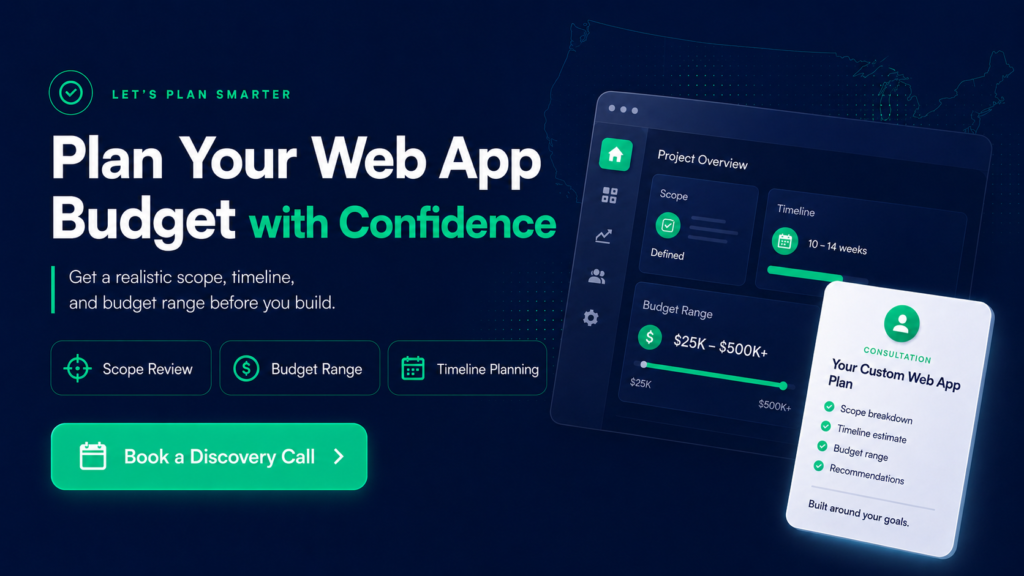
Costs in the US market usually fall between $25,000 and $500,000 or more. Here is a rough guide by project size:
- Simple web app or MVP: $25,000 to $60,000
- Mid complexity app with user roles, integrations, and dashboards: $60,000 to $150,000
- Complex enterprise app with multi-tenant setup, AI features, and strict compliance: $150,000 to $500,000+
According to Clutch and public rate reports from major industry directories, average project spend for custom web application development with US agencies sits in the $50,000 to $250,000 range for most small and mid-market clients. Figures are indicative and vary by sector.
Web application development pricing by app type
The table below compares typical timelines and cost ranges for common project types in the USA. Use it as a starting point when you shape your brief.
| App type | Timeline | Est. cost (USD) | Best for |
| Simple / MVP | 2 to 4 months | $25,000 to $60,000 | Startups testing an idea |
| Mid complexity | 4 to 7 months | $60,000 to $150,000 | Growing SMBs, service portals |
| SaaS platform | 6 to 10 months | $120,000 to $300,000 | Product companies scaling up |
| Enterprise app | 9 to 14 months | $250,000 to $500,000+ | Large firms, regulated sectors |
What affects web application development cost?
Several factors shape the final invoice. Understanding them helps you plan and negotiate:
Scope and features:
More features mean more design, code, and QA. Real-time chat, payments, and AI add extra layers of work.
Tech stack:
Modern stacks like React, Node.js, Python, and cloud native services may cost more upfront but save on maintenance.
UI and UX design:
Custom design costs more than templated screens, but it drives engagement and retention.
Integrations:
Payment gateways, CRMs, ERPs, and third-party APIs add engineering hours.
Team seniority and location:
US-based senior developers charge premium rates. A blended team can bring the average down without hurting quality.
Compliance and security:
HIPAA, SOC 2, PCI DSS, and GDPR each add planning, testing, and documentation time.
Post-launch support:
Monitoring, patching, and feature updates should be part of the budget from day one.
Hourly rates in the US market
Rates vary by role, seniority, and city. Typical ranges reported by Clutch, Upwork Enterprise, and industry salary surveys are shown below.
| Role | Seniority | Hourly rate (USD) |
| Junior developer | Entry level | $50 to $90 |
| Mid-level developer | 3 to 5 years | $90 to $140 |
| Senior developer | 6+ years | $140 to $200 |
| Solution architect | Lead role | $180 to $250 |
| Product designer | Senior | $90 to $170 |
Coastal cities such as San Francisco, New York, and Boston sit at the top end. Firms in Texas, Florida, and the Midwest often price 15 to 25 percent lower for similar quality.
What Affects Web Application Development Cost?
Six factors move the number more than anything else.
Scope and feature depth
A lead form is far simpler than a role-based customer portal. Every screen, every task, and every edge case adds hours.
Design complexity
A clean template-driven UI costs less than a fully bespoke design system with motion, personalized visuals, and accessibility audits.
Integrations
Stripe, Salesforce, HubSpot, HL7 in healthcare, or bank APIs in fintech all add engineering time. Some are plug-and-play. Others take weeks.
Tech stack choices
Modern stacks like Node.js, React, Next.js, Python, and .NET Core are widely supported. Niche stacks or legacy systems raise the costs as senior talent is harder to source.
Compliance and security
HIPAA, SOC 2, PCI DSS, or GDPR readiness can add 15 to 30 percent to your total budget. In regulated industries, it isn’t optional.
Team location and seniority
This is the biggest lever. A US senior developer might bill $180 per hour. A US mid-level engineer, around $110. Nearshore or offshore blended teams can bring rates down to $60-$90 while maintaining reasonable quality if the vendor is solid.
Onshore, Nearshore, and Offshore Pricing
For US buyers evaluating a custom web app development company in the USA, here’s how the sourcing models stack up.
Total cost of ownership matters more than the hourly rate. Poor code costs more over time.
Hidden Costs Businesses Often Miss
Sticker price on a proposal isn’t the whole story. Several line items get underestimated or left out entirely in early quotes. Watch for these before you sign anything.
Cloud hosting and infrastructure:
AWS, Azure, or GCP bills for a mid-sized web app mostly run $500 to $5,000 per month once you’re live.
Third-party licenses:
Payment gateways, mapping APIs, email delivery, analytics tools, and premium libraries. Individually small, collectively significant.
Security testing:
Penetration tests from a reputable firm start around $8,000 for a basic app and go up quickly for larger systems.
Data migration:
Moving from legacy systems takes time. Plan for these costs upfront.
Training and change management:
Your users need to adopt the app. Documentation, videos, and internal enablement time count.
Ongoing DevOps:
CI/CD pipelines, monitoring, alerting, and on-call coverage. Some vendors include it and many charge separately.
How long does it take to develop a custom web app?
Timelines follow scope. A rough guide:
MVP:
This takes about 8 to 12 weeks
Mid-complexity app:
This is around 4 to 6 months
SaaS product:
This takes about 6 to 10 months
Enterprise platform:
It is sometimes longer, as it takes 9 to 18 months.
The web application development process usually splits into discovery, which is 2 to 4 weeks; design, which is 3 to 6 weeks; build, which varies; QA, ongoing plus integration tests; and launch. Skipping discovery is the fastest way to blow past both timeline and budget.
How can businesses reduce web app development costs?
Cost control starts with clarity. Here are practical steps that keep quality high while trimming the invoice:
Start with an MVP:
Ship a small, useful version first, then grow it based on real user data.
Prioritize features:
Use a scoring method like RICE or MoSCoW to keep the backlog focused.
Reuse proven components:
Design systems, open-source libraries, and cloud services cut build time.
Blend teams:
Combine US-based product leads with global engineering talent for balanced pricing.
Maintenance plan:
Budget 15 to 20 percent of build cost per year for updates, security patches, and small features.
Choose the right contract:
Fixed scope suits well-defined work; time and materials fit discovery-heavy or evolving products.
Common challenges in custom web application development
Unclear requirements:
Scope creep is the top reason projects run over budget.
Weak QA:
Bugs found in production cost far more than bugs found in staging.
Poor handover:
Without clear docs, in-house teams struggle to maintain the app.
Vendor lock-in:
Overly custom code on niche platforms can trap you later.
Underestimated cloud costs:
Traffic spikes and data storage bills add up quickly.
How to choose a custom web app development company USA?
The vendor decision is more important than the tech stack. You can evaluate web app companies by their case studies, technical skills, process, and discovery approach. A partner that pushes back on unclear requirements is worth more than one that accepts it.
ACME One provides custom software development across cloud, data, and modern web apps. This software serves between mid-market and enterprise clients across the USA. Whatever partner you choose, make sure to verify their engagement model, IP ownership terms, and post-launch support before signing.
Affordable web app development in the USA isn’t always the cheapest option. These options provide realistic pricing, clear delivery, and maintainable code.
Final Remarks
Web app development in the USA is an investment, and not a line item. Businesses get better value with disciplined budgeting, clear scope, and a partner who explains the tradeoffs. As you get those right, the cost question becomes a lot easier to answer. If you’re at the start of your evaluation, put your energy into three things before you worry about the final number. The $10,000 to $25,000 you spend there is the best insurance money you’ll buy on the whole project.