The AI infrastructure market crossed a breaking point in 2025. Building AI-powered products is no longer the hard part; rather, managing them at scale is.
Developers and engineering teams now face a choice that shapes everything downstream. This choice comes down to running your own AI workflow automation platforms or relying on a cloud provider to manage it. Both options are more mature. Both have real tradeoffs. The wrong pick can slow your team down for months.
This guide is for developers, tech leads, and engineering managers who need an accurate picture of the self-hosted vs cloud debate in 2026. We’ll explore the costs and enterprise needs of each approach. You’ll also learn how to choose the right fit for your team.
If you are interested in the broader state of AI infrastructure trends in 2026, Gartner’s latest research is a useful reference point before diving in.
What Is an AI Automation Platform?
An AI automation platform enables you to build, position, and manage AI-driven workflows. This is a connective tissue between your data, your models, and your business logic.
Good platforms automate routine tasks like agent orchestration, retries, logging, and API integrations. They also route outputs to the right systems automatically. Your team focuses on what the AI should actually do instead of writing a boilerplate.
The best AI automation platforms for developers in 2026 go a step further. They support generative AI automation, multi-agent coordination, and production-grade clarity out of the box. For a solid primer on what these platforms can do, AWS has a useful overview of AI workflow coordination concepts worth bookmarking.
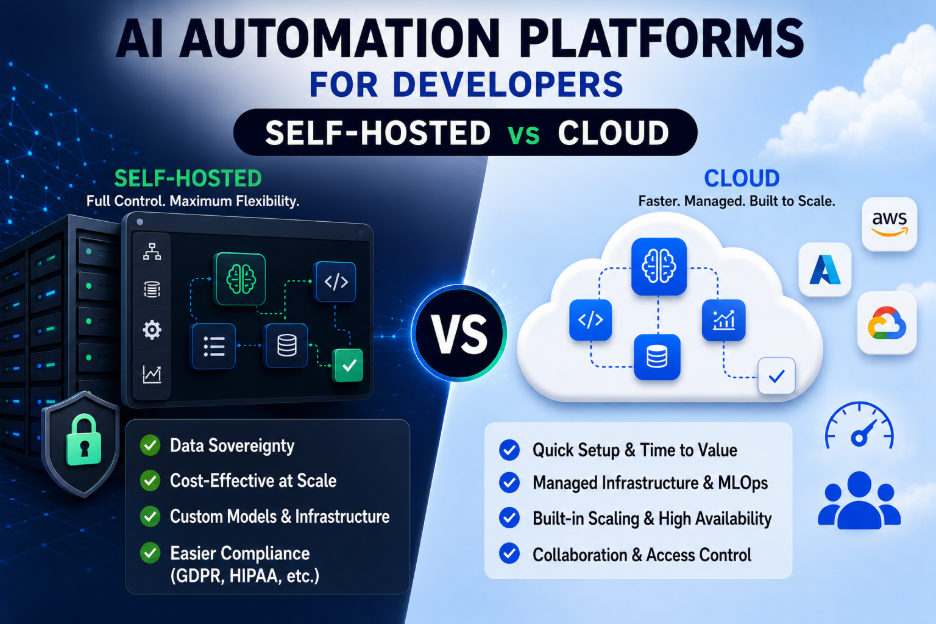
Self-Hosted vs Cloud: The Core Trade-Off
There’s no objectively correct answer here. The right choice depends on your team’s constraints.
Self-Hosted AI Platforms
Self-hosted options give you full control over where your data lives and how your infrastructure scales. Popular open-source AI agent frameworks like n8n (self-hosted), Apache Airflow, and Prefect fall into this category.
Where self-hosted wins:
Data sovereignty: Regulated industries such as finance, healthcare, and government often can’t send data to third-party clouds. Self-hosted AI solutions keep everything in-house.
Cost at scale: Once your usage grows, cloud per-run pricing adds up fast. Owning the structure can be cheaper at high volume.
Custom models: If you’re running fine-tuned or private models, you need an environment to control.
Compliance: For teams in the USA, UAE, or UK dealing with GDPR, HIPAA, or local data residency laws, self-hosted avoids a lot of paperwork.
Where self-hosted struggles:
- You own the maintenance, such as upgrades, security patches, and tracking, which is on your team.
- Initial setup takes longer, especially for enterprise AI workflow automation at scale.
- Smaller teams often don’t have networking and tech.
Cloud AI Automation Platforms
Cloud-based AI automation tools remove the operational load entirely. You get a managed environment, built-in scaling, and usually a faster path from idea to production.
Platforms in this space have matured considerably. Vendor-managed solutions now offer serious security controls, making them viable even for larger organizations. Google Cloud’s AI automation for developers’ suite and Microsoft Azure AI are two standards worth checking if you’re evaluating managed options.
Where cloud wins:
Speed: Spin up new tasks in hours, not days.
Managed MLOps: Model versioning, A/B routing, and deployment pipelines are handled for you.
Team collaboration: Cloud platforms usually include role-based access, audit logs, and shared workspaces out of the box.
Elastic scaling: Burst traffic? The platform scales without you having to touch anything.
Where cloud falls short:
- Vendor lock-in is real. Transferring complex tasks later is painful.
- Costs can spike unpredictably as usage grows.
- You’re trusting a third party with your data and uptime.
What Enterprises Actually Need?
Secure AI workflow automation platforms for enterprises need to clear a higher bar than solo developer tools.
Enterprise AI automation software comparison often comes down to four things: security certifications (SOC 2, ISO 27001), role-based access control, integration depth with existing systems (Salesforce, SAP, legacy databases), and SLA guarantees.
ACME One has started addressing this directly, while offering enterprise-ready automation infrastructure that bridges the gap between cloud accessibility and the control that large organizations require.
If you’re evaluating enterprise AI automation platforms, audit every vendor against your actual compliance requirements. A slick sample doesn’t mean the platform will pass your security review.
Developer Experience: What to Look For
Beyond the hosted vs managed question, pay attention to the actual developer experience.
The top cloud-based AI automation tools in 2026 offer:
- Native support for popular AI infrastructure (OpenAI, Anthropic, Mistral, local models)
- Python-first or TypeScript-first SDKs
- Visual editors for non-technical teammates, without sacrificing code-level control
- Real-time logs and replay for debugging failed runs
- Git-native workflow definitions so you can version-control everything
AI workflow management gets messy fast. A platform that forces you to click through a UI to troubleshoot production failure will slow your team down. Prioritize observability. The MLOps Community is a good resource if you want to see how other teams handle this in production.
Final Remarks
In conclusion, the self-hosted vs cloud question doesn’t have a permanent answer. Most mature teams don’t stay in one camp forever. They often start with the cloud to move fast, then transfer critical tasks to self-hosted as data sensitivity and cost pressures grow.
What matters right now is making a decision based on your actual situation. Map your regulatory requirements first and then look at your team’s operational capacity.
AI workflow automation platforms will keep moving. New frameworks will appear, vendor pricing will shift, and open-source tooling will match managed offerings. The teams that build portable, well-documented tasks today will have the easiest time adapting.