
For Dubai CIOs, failed releases remain a serious operational risk. One failed deployment can disrupt payments, affect customer data, and create regulatory issues.
The demand for faster software releases continues to grow. Software release cycles are accelerating across UAE organizations. These include banks, healthcare, retail, and government. Manual release processes can’t keep up with frequent updates.
DevOps consulting services close that gap. They automate deployments, monitoring, and rollback. Pipelines verify each release before production.
This blog breaks down how DevOps reduces deployment risks, what a modern engagement covers, and what to look for when you choose a partner.
What Are DevOps Consulting Services?
DevOps consulting unites development, operations, and security. A good partner improves pipelines to reduce waste and risk.
Typical DevOps services include:
- CI/CD pipeline design and implementation.
- Infrastructure as Code setup on public or private cloud.
- Positioning automation and release automation.
- DevOps security, often called DevSecOps.
- Tracking, observability, and alerting.
- Team training and DevOps support services after go-live.
The scope varies. Some businesses need a one-off assessment. Others need full DevOps deployment services, including hands-on engineering across months of transfer work. Enterprise DevOps services usually combine both, with a roadmap that scales as the platform matures.
The end goal is the same, which is to turn every release from a gamble into a routine event. That means smaller changes, faster feedback, and cleaner recovery when something breaks.
Why You Need DevOps Now?
Software release cycles keep shrinking. What used to ship every quarter now ships every week, sometimes every hour. Customers expect updates, patches, and new features on demand. Regulators expect audit trails for every change.
Manual deployment cannot keep up. Human error is the leading cause of production incidents in many industry surveys, and the risk grows as systems become more distributed. A single misconfigured environment variable can take down a payment gateway.
Three key factors are driving DevOps adoption across the UAE, KSA, and Qatar:
- National digital programs are increasing demand for fast, secure software delivery.
- Banking, healthcare, and government sectors are rapidly moving to the cloud.
- Rising cyber threats that make late-stage security reviews impractical.
DevOps addresses all three. Automation removes the guesswork. Security shifts left, into the pipeline itself. Monitoring catches problems before customers notice.
Waiting a year to modernise your release process means a year of avoidable incidents, missed deadlines, and unhappy users. The cost of delay is higher than the cost of the engagement.
How Does DevOps Reduce Deployment Risks?
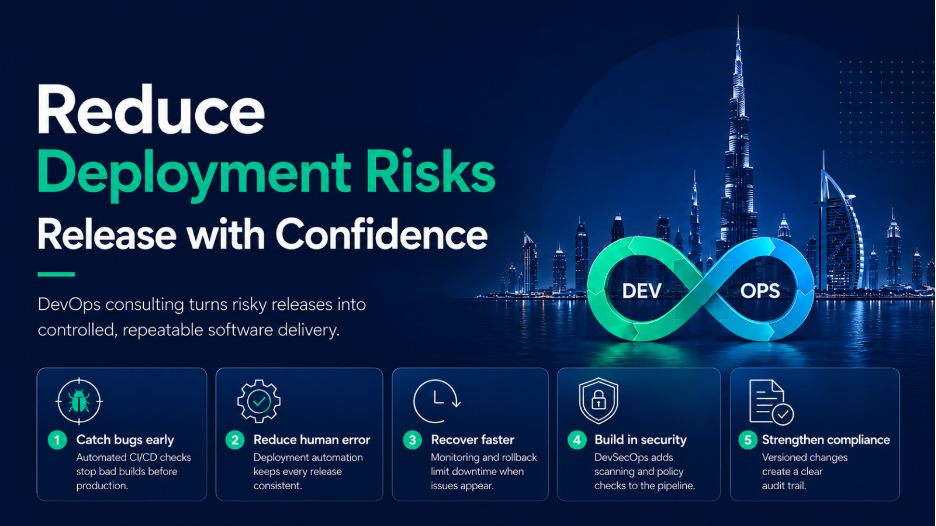
DevOps lowers deployment risks in five practical ways. Each practice addresses common release risks.
CI/CD Pipelines Catch Bugs Early
Continuous Integration and Continuous Delivery pipelines run every code change through a battery of automated checks. Unit tests, integration tests, security scans, and quality gates all fire within minutes of a commit.
CI/CD consulting services usually start here, because the pipeline is the foundation for everything else. Successful tests move the change closer to release. When they fail, the change stops. Nothing gets deployed on hope.
The impact is measurable. Teams with mature CI/CD workflows report far fewer defects reaching customers, because most bugs die in the pipeline instead of in production.
Deployment Automation Removes Human Error
Manual deployments involve tickets, checklists, and late-night calls. Each step adds risk of errors or missed actions.
Deployment automation replaces the checklist with code. The same script runs across all environments. Version control tracks who changed what, and audits become straightforward.
For regulated sectors like banking and healthcare, this audit trail is not optional. It is the difference between passing an inspection and rewriting a control document from scratch.
Deployment Monitoring and Fast Rollback
DevOps can’t remove every deployment risk, but it speeds up recovery. Real-time monitoring catches performance issues as they happen.
Automated rollback restores the last stable version when issues appear. The bad release lasts minutes, not days. Users often never notice.
Canary releases and blue-green deployments add another layer of release control. The new version first reaches a small group of users. If it holds up, traffic expands. If issues occur, their impact remains limited.
DevOps Security Built Into the Pipeline
Delayed security reviews can leave critical issues unresolved before release. DevOps security moves scanning and policy checks into the pipeline itself.
Every build runs automated security scans and secret detection. Frameworks from NIST and OWASP guide which controls to apply and when.
This supports safer releases with fewer last-minute issues. Security flaws are identified early, before they become costly risks.
Release Automation Supports Faster, Safer Releases
Release automation ties everything together. Approvals, deployments, tests, and alerts run in a workflow.
DevOps services for faster software releases rely on this coordination heavily. Teams ship faster without compromising release safety.
Application deployment becomes predictable. This consistency makes DevOps a great business advantage.
Traditional Deployment vs DevOps Deployment
The table below shows how the two models compare on the metrics that matter most to enterprise leaders.
| Metric | Traditional Deployment | DevOps Deployment |
| Deployment frequency | Weeks or months | Multiple per day |
| Change failure rate | 30 to 60 percent | 0 to 15 percent |
| Time to recover from incident | Days | Under 1 hour |
| Lead time for changes | 1 to 6 months | Less than 1 day |
| Security testing | Late-stage, manual | Automated, in pipeline |
| Rollback capability | Manual, slow | Automated, fast |
| Audit trail | Ticket-based, patchy | Code-based, complete |
DevOps by the Numbers
The business case for DevOps is clear when you look at the data.
- Elite teams deploy up to 973 times more often.
- Mature DevOps teams keep change failure rates at 15% or less. Teams without automation may see rates of 46% to 60%.
- High-performing teams recover from incidents in under an hour. Others may take days or weeks.
- IDC and Gartner highlight DevOps and cloud automation. Both help speed up enterprise software delivery in the Middle East.
- Dubai and Riyadh are driving strong cloud growth across MENA.
These figures are indicative and should be verified against your own data before publication or investment decisions.
DevOps Consulting for Businesses in Dubai
Dubai’s enterprise landscape rewards speed and reliability in equal measure. Banks compete on digital experience. Government entities must deliver new citizen services quickly. Retail and logistics firms scale with online demand.
DevOps consulting services for businesses in this environment need to cover more than just tools. They must address UAE regulations, data residency, and distributed teams.
Best DevOps consulting services in the region combine three things. These include deep engineering skill, familiarity with Dubai’s compliance landscape, and the ability to train in-house teams so knowledge stays with the client. ACME One works with enterprises across the UAE to plan and run this kind of engagement, from initial assessment through long-term DevOps support services.
CIOs need to modernise without increasing outage risk. The right partner keeps migration controlled and predictable. Small wins blend. Confidence grows. Releases stop being events and start being routine.
How to Choose the Best DevOps Consulting Services?
Not every DevOps engagement delivers. Some end in shelfware, others in half-built pipelines that no one owns.
When evaluating DevOps automation services or enterprise DevOps services, look for:
- Clear delivery methodology with defined breakthrough.
- Case studies from similar industries and geographies.
- Certified engineers on the delivery team.
- Clear plans for handover, team training, and ongoing DevOps support.
- Security inserted from day one, and not added on later.
- Transparent pricing and change control.
You can ask to see sample pipelines, not just slideware. Talk to previous clients directly. Set clear goals for deployment speed and failure rates. Track recovery time to prove the programme’s value.
Final Remarks
The right DevOps practices reduce deployment risks. DevOps consulting services provide the pipelines, controls, and monitoring that turn releases into a routine business activity rather than a source of stress.
Traditional methods struggle under modern release pressure. DevOps handles it by design.
Dubai enterprises face tighter deadlines and rising expectations. The focus now is on how quickly to adopt DevOps.