If you’ve started discovering application modernization cloud projects, you’ve already hit the question that nobody gives a straight answer to. This question involves: what does this actually cost?
The answer is that it depends on various elements. But that doesn’t mean you can’t build a realistic budget. Currently, cloud transformation has matured to the point where pricing patterns are clearer than they were just a few years ago. Understand the real cost of cloud modernization. See how enterprises in the USA, UAE, and UK are planning cloud adoption in 2026.
What Is Cloud Application Modernization?
Cloud application modernization updates legacy applications. It helps them run efficiently in the cloud. It ranges from simple cloud migration to full cloud native redesign.
This is not a standardized project. The scope, timeline, and application modernization cost depend on what you’re starting with, where you want to go, and how fast you need to get there.
Common modernization approaches include:
- Rehosting: Move applications to the cloud with minimal changes.
- Replatforming: Make targeted adjustments to take advantage of cloud capabilities.
- Refactoring: Redesign core architecture for cloud native performance.
- Rebuilding: Rewrite from scratch using modern frameworks.
- Replacing: Retire legacy systems and adopt SaaS alternatives.
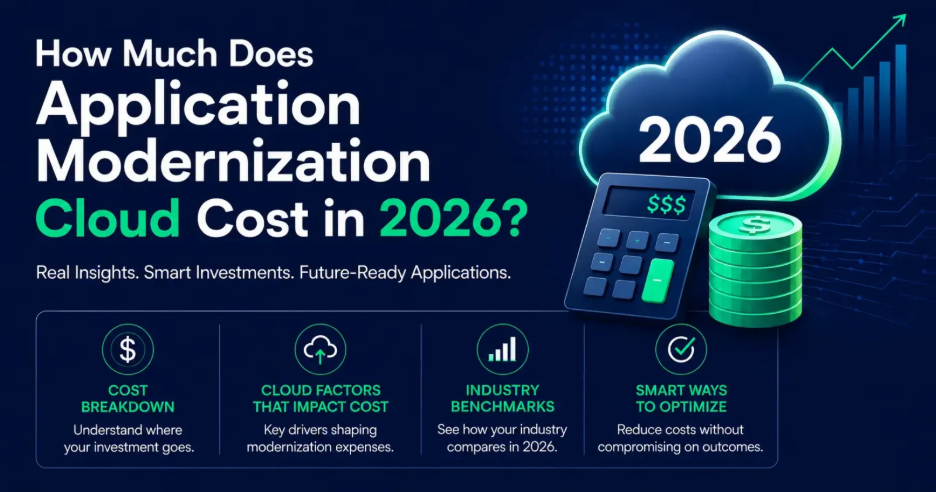
Cloud Application Modernization Cost: What Are the Real Numbers in 2026?
Enterprise cloud application modernization pricing varies widely. Here’s a realistic breakdown based on project scope:
| Scope | Estimated Cost Range | Typical Timeline |
| Single legacy app rehost | $25,000 – $100,000 | 4 – 8 weeks |
| Mid-size app replatforming | $100,000 – $400,000 | 3 – 6 months |
| Full portfolio refactoring | $500,000 – $2M+ | 6 – 18 months |
| Enterprise-wide cloud transformation | $2M – $10M+ | 1 – 3 years |
| Cloud modernization for healthcare orgs | $300,000 – $2M+ | 6 – 24 months |
These costs reflect cloud modernization projects in the USA, UK, and UAE. Labor rates, vendor selection, and infrastructure choices all shift to the final number.
What Factors Influence Application Modernization Costs?
No two modernization projects cost the same. Here are the variables that most significantly drive the price up or down.
Age and Complexity of Legacy Systems
Modernization costs rise when legacy systems lack documentation. Outdated technologies and monolithic architectures add complexity. The older and messier the codebase, the more hours engineers spend just understanding what’s there before they can change it.
Number of Applications in Scope
Modernizing one app is far simpler. Managing dozens of interconnected systems is a different challenge. Large-scale modernization usually requires phased delivery, increasing time and cost.
Target Cloud Environment
Moving to AWS, Azure, or Google Cloud each carries different licensing, tooling, and migration costs. Hybrid and multi-cloud configurations add another layer of complexity. Cloud pricing changes over time, affecting long-term ownership costs.
Regulatory and Compliance Requirements
Healthcare cloud modernization often costs more than in other sectors due to HIPAA and HITRUST. Compliance requirements increase complexity and cost. Financial services in the UAE and UK face similar compliance overhead with ADGM, FCA, and GDPR requirements. Compliance work adds both cost and time.
In-House Capability vs. External Partners
Organizations with cloud expertise rely less on consultants. As a result, modernization costs are lower. Enterprises often bring in specialists for key phases. Cloud native capabilities can be hard to maintain internally.
How Do Enterprises Calculate Cloud Modernization Budgets?
A well-structured digital transformation strategy approaches enterprise cloud modernization budgeting in three phases.
Phase 1: Discovery and Assessment
Before any budget is finalized, a thorough assessment of the existing estate application is essential. This typically costs $15,000 to $75,000 but prevents expensive surprises later. The output is a prioritized modernization roadmap.
Phase 2: Pilot Migration
Pick one or two lower-risk applications and modernize them first. It validates your cloud strategy and uncovers hidden challenges. It also supports smarter investment decisions.
Phase 3: Scaled Delivery
Once the approach is proven, scale across the portfolio using consistent patterns and tooling. Phased delivery lowers risk and spreads costs. This approach is often preferred for approval.
Real-World ROI: Is Cloud Application Modernization Worth the Cost?
Cost is only half the equation. A strong cloud strategy delivers the ROI needed to justify investment. Here’s how the numbers typically play out for enterprise organizations.
Infrastructure Cost Reduction
Cloud adoption can significantly reduce infrastructure expenses. Organizations often see 30–50% savings over three years, according to McKinsey research on enterprise cloud adoption. Organizations running legacy systems pay for capacity they rarely use. Cloud services pricing models flip that dynamic, so you pay for what you actually consume.
Developer Productivity Gains
Legacy modernization removes the maintenance burden that consumes engineering time. Teams maintaining old systems often spend 60 to 70 percent of their capacity on keeping the lights on. Cloud native architecture reduces maintenance demands. Developers can focus more on innovation.
Faster Time to Market
Enterprise software modernization shortens release cycles. Cloud native applications support rapid deployment and scaling. They improve reliability with automated recovery. For businesses competing in fast-moving markets across the USA, UAE, and UK, that speed is a direct commercial advantage.
A Simple ROI Example
Consider a mid-size enterprise spending $1.2M annually on legacy infrastructure and maintenance. A $400,000 replatforming program reduces that annual spend to around $650,000 by year two. That’s a net saving of roughly $550,000 per year once the modernization pays for itself, typically within 18 months. Stack in productivity gains and faster release cycles, and the business case becomes hard to argue against.
Enterprise modernization gains support with a clear business case. A structured cost-benefit model helps secure approval.
How does ACME One Support Enterprise Cloud Application Modernization?
ACME One works with enterprise clients across the USA, UAE, and UK to plan and execute cloud transformation programs. From planning to implementation, the team manages modernization. Businesses migrate to modern cloud environments smoothly.
Final Remarks
In conclusion, application modernization cloud projects are complex. Successful enterprises start with a proper assessment. They view modernization as a business investment, not just an IT cost.
A successful cloud strategy starts with learning your current environment. Define your goals and build the business case first. Enterprise cloud application modernization doesn’t have to be a budget mystery. With the appropriate assessment and a progressive approach, modernization stays manageable. Legacy systems can move to the cloud within approved budgets.