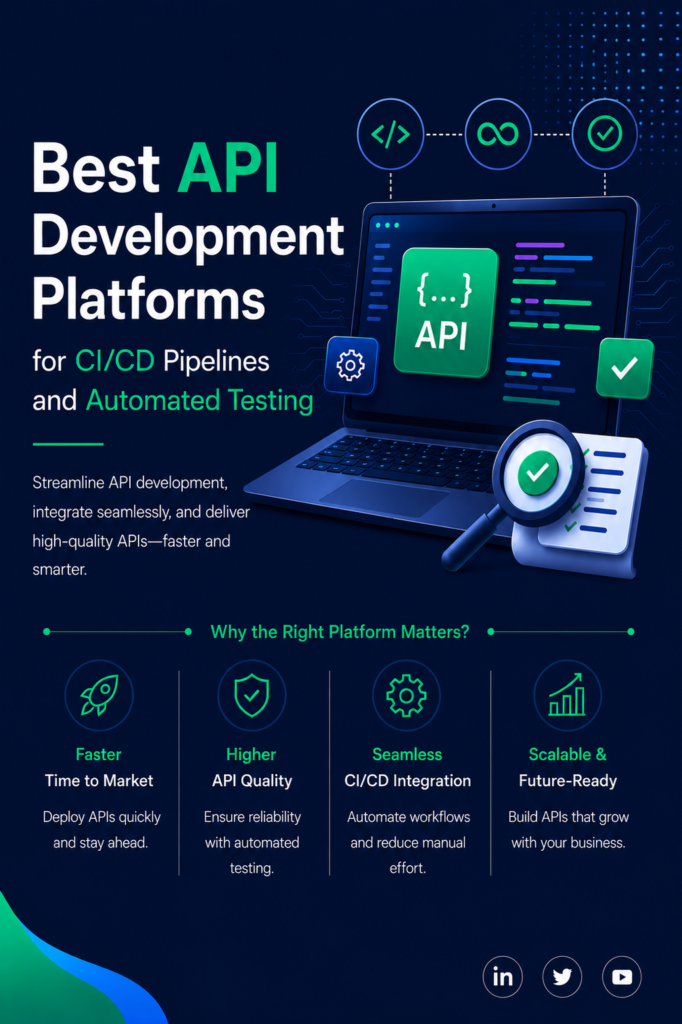
Modern software teams ship fast. That speed only works if your APIs hold up every time and across every environment. For enterprises operating in the USA, UAE, and UK, choosing the right api development platform is the main priority for most companies. It's a primary part of how quality gets delivered.
This guide breaks down the best API testing platforms for automated testing and CI/CD so your team can make appropriate decisions.
CI/CD pipelines run on confidence. Every code push activates a chain of automated checks. If your APIs fail silently, that confidence collapses fast.
API test automation catches issues before they reach production. Verifies contracts and load performance. Catches issues early in the development cycle. Done right, incorporation testing becomes a safety net built directly into your pipeline.
So how do CI/CD pipelines benefit from API automation? This involves fewer surprises in production, faster releases, and less time spent on manual regression checks.
Before comparing tools, it helps to know what actually matters. Here's what enterprise teams should prioritize:
CI/CD Integration: The platform should merge smoothly with your CI/CD pipeline.
API Test Automation Depth: Look for support for REST, SOAP, GraphQL, and gRPC. You want pre-planned tests, data-driven scenarios, and reusable test suites.
API Performance Monitoring: Load and stress testing should be easy to configure. You need to know how your APIs perform under pressure.
Service Virtualization: This service enables teams to test against dependencies that aren't available yet. It keeps testing moving even when third-party services are unstable.
Reporting and Observability: Clear test reports save troubleshooting duration. You can look for dashboards that show failure trends.
An online retailer in the USA prepares for Black Friday. Their checkout API worked fine during regular testing, but at 10 times the normal load. Without API performance monitoring built into their testing platform, this would be discovered during the sale itself.
Integrated load testing reveals the problems early. The team fixes it before launch. Black Friday runs without incident.
An NHS-adjacent digital health platform merges with multiple hospital management systems. Each system speaks a slightly different dialect of HL7 FHIR. The team needs to run integration testing on all of them, but not all systems are available in the test environment simultaneously.
Service virtualization creates virtual hospital systems. Enabling continuous API testing without external dependencies. Problems that would have taken days to surface now show up in minutes.
A distribution company operating across the GCC region launches a new shipment tracking API. The platform needs to serve requests from Dubai, Riyadh, and Muscat simultaneously with consistent response times. Their API testing framework runs performance benchmarks per region as part of every shipment.
When a setup drift causes the Riyadh endpoint to respond 40% slower than the others, the CI/CD pipeline flags it before the release reaches production. The issue turns out to be a missing CDN rule, fixed in under an hour.
Top API monitoring and testing tools for enterprises
Postman
Postman is the most widely used API development platform globally. This platform handles everything from exploration to full test mechanization. Its collection runner and Newman CLI make it straightforward to run API tests inside any CI/CD pipeline.
Enterprise plans add role-based access, audit logs, and SSO.
Best for: Teams that want a tool for both development and testing.
ReadyAPI (SmartBear)
ReadyAPI is primarily designed for enterprise API testing. This platform brings testing and digitization together. Designed for detailed API quality assurance. It merges with major CI/CD tools and scales well across large organizations.
It has a tough learning curve but offers deeper integration testing capabilities.
Best for: Enterprises needing advanced testing with built-in service virtualization.
Katalon Studio
Katalon combines API and UI testing in a single platform. This platform supports API testing and pipeline integration. Built for QA teams with limited coding experience.
An affordable option for teams managing both web and API tests.
Best for: Teams that want API and UI testing without managing separate tools.
Tricentis Tosca
Tosca is a comprehensive test automation platform with durable API testing capabilities. Its model-based approach reduces test maintenance as APIs evolve.
Enterprise-ready for large testing environments. Delivers powerful integration testing with minimal code.
Best for: Large enterprises with complex microservices and compliance requirements.
REST Assured (Open Source)
REST Assured is a Java library designed for testing RESTful APIs. It's built for developers who want lightweight, code-first control over their test automation. It fits naturally into Maven or Gradle builds and drops into any Java-based CI/CD pipeline.
Designed for developers rather than GUI users. Provides authentic API testing capabilities.
Best for: Developer-led teams that prefer code-based testing over visual tools.
How Enterprises Choose the Right API Testing Solution?
The choice depends on team size, skills, and API complexity. Existing CI/CD tools also play a key role.
Small teams often start with Postman and grow from there. Large organizations often need platforms like ReadyAPI or Tosca to succeed. They support service digitization and performance testing at scale.
Enterprises can rely on ACME One to assess API quality assurance platforms. You can choose solutions that align with your technology stack and future goals.
Budget matters too. Open-source options like REST Assured are durable, even though they require engineering investment. Commercial platforms cost more upfront but reduce setup and maintenance overhead.
Common Mistakes to Avoid When Setting Up API Testing in CI/CD
Getting the platform right is only half the task. Here are the mistakes that enterprise teams consistently slip up on.
Testing only the happy path: Most API tests cover successful requests. Unexpected inputs, void values, and timeouts are common causes of production failures. A complete API quality assurance strategy tests failure modes just like it tests success.
Skipping contract testing: When two teams own different services, changes on one side can create problems for the other. Consumer-driven contract testing with tools like Pact catches inconsistencies before runtime failures.
Not versioning your test suites: As APIs change, so should your tests. Teams that treat test code as a secondary concern end up with fragile issues that fail for the wrong reasons. Manage test collections like application code, with version control, reviews, and ownership.
Ignoring test environment parity: Tests may break in staging due to unstable environments. Test data, authentication, and network settings often vary across environments. You can build an environment-specific assessment into your test setup from the initiation process.
Final Remarks
In conclusion, getting api development platform right is not about having the most tools. It's about choosing the right platform. One that integrates well and catches production issues.
These platforms provide a great foundation for API testing and CI/CD automation. Choose the solution that best fits your team's tasks, scale, and testing requirements. You can choose based on what your team can actually use well.