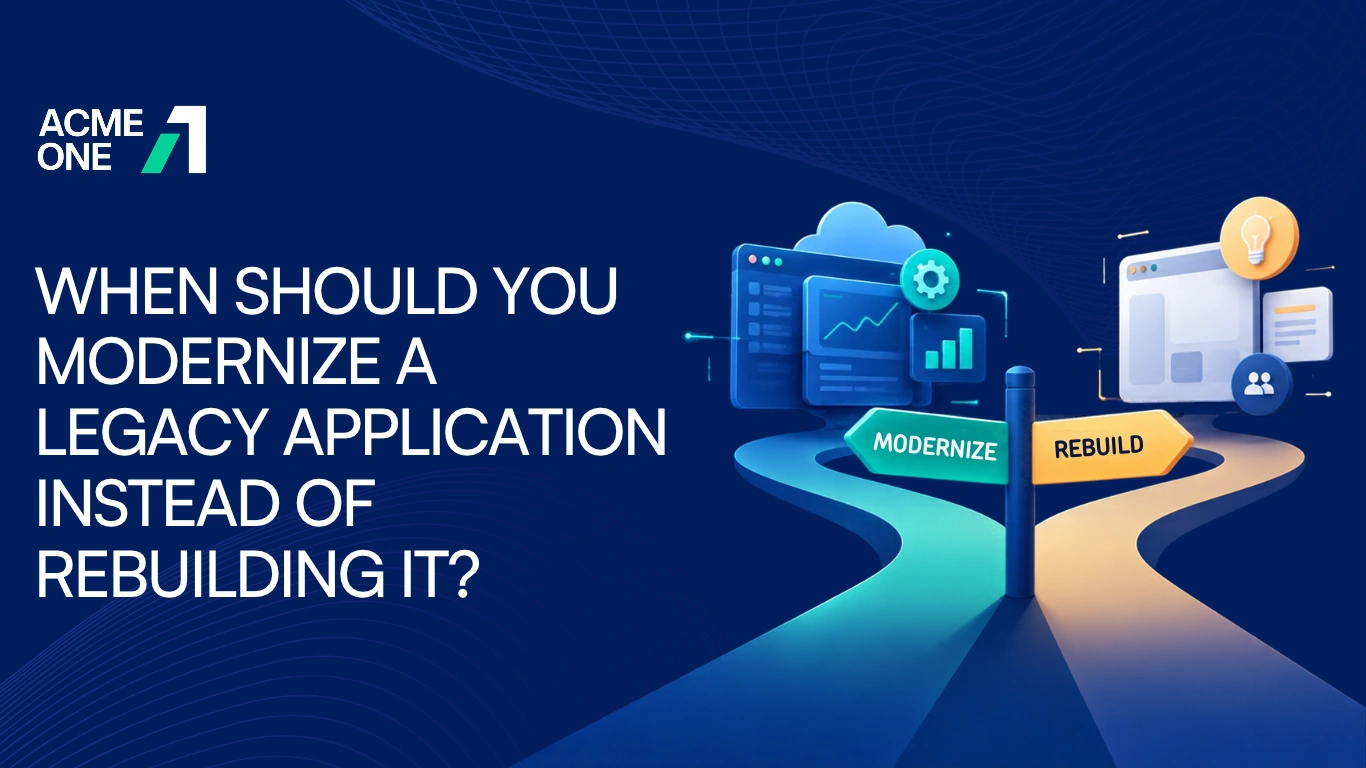
The hardest modernization decision isn’t how to modernize an application. It’s whether the existing system is still worth saving. Modernization isn’t always safer. Rebuilding isn’t always cleaner.
Legacy application modernization makes sense when two things are true. The system still holds valuable business logic, and you can improve its structure in steps. Rebuilding makes sense when the structure itself blocks change. Age and maintenance pain matter less than architecture, change cost, and dependency risk. A 15-year-old system with clear modules can be a better candidate than a five-year-old one rushed into production.
Modernization and rebuilding solve different problems
Modernization keeps what still works. It changes what limits security, maintenance, scale, or speed of delivery. That might mean refactoring, replatforming, or upgrading frameworks. It might mean cloud migration, API enablement, rearchitecting a few components, or replacing modules one at a time.
Rebuilding replaces most or all of the application. It brings a new design, data model, and stack. It can happen in stages rather than one cutover.
Why rebuilding from scratch is not automatically cleaner
A rewrite removes old code. It doesn’t remove business complexity.
Systems collect behavior over the years. Think of a regional discount, a manual approval for large orders, or an edge case added after an audit. Some of this is documented. Some lives only in the code, the data, or the habits of the people who run the system.
A rebuild has to find that behavior before it can reproduce it. It also has to move data shaped by old decisions. It has to keep integrations working and support workflows no spec describes. Until the new system catches up, teams run both and keep their data in sync.
Martin Fowler’s strangler fig pattern answers this risk. It replaces the old system piece by piece. In his original description, Fowler said reduced risk was the main reason to choose it over a cutover rewrite.
When does legacy application modernization still make sense?
Modernization wins when the system holds something valuable that people understand. Look for these signs:
- The business logic is correct, trusted, and current.
- Problems sit in specific areas, such as a slow reporting layer or an old interface.
- The architecture has clear boundaries between parts.
- The data model still fits the business, even if the schema is messy.
- Teams know the dependencies and integrations, or can map them.
- Security gaps can be closed without redesigning the core.
- Planned business needs fit the current design.
In Working Effectively with Legacy Code, Michael Feathers treats legacy code as code without tests. Without tests, you can’t tell whether a change helped or hurt. Characterization tests record what the system does today. With them in place, teams can refactor in small, safe steps.
Weak test coverage isn’t a reason to rebuild, though. If the team doesn’t know current behavior well enough to test it, it can’t reproduce it either.
When does rebuilding become the better option?
A rebuild makes more sense when several structural problems hit the core at once. No single sign is enough. Watch for these:
- Small changes ripple widely, and engineers can’t predict the impact.
- The architecture blocks what the business now needs, such as real time processing or multitenancy.
- Core runtimes, frameworks, or databases are unsupported, and an upgrade would amount to a rewrite.
- The data model can’t support new products without heavy workarounds.
- Security fixes require redesigning major system boundaries.
- Business rules are tangled with outdated infrastructure.
- Performance limits come from the design, not hardware or settings.
- The people who understood the system have left.
- Past modernization work added layers instead of removing them.
The last sign is often the clearest. Each project adds another adapter or sync job, yet change keeps getting more expensive. You’re paying to keep the constraint.
Technical debt is not the same as architectural debt
Technical debt sits inside the code. It includes old libraries, messy functions, missing tests, duplicated logic, and workarounds that became permanent. Teams can pay it down bit by bit while the system runs.
Architectural debt sits in the structure. A shared database might stop teams from making changes on their own. Critical modules might depend on each other in circles. Weak boundaries might force every feature to touch unrelated parts. Or the core data model might no longer fit the business.
Technical debt is a reason to modernize. Architectural debt makes every future change cost more. Still, it doesn’t always call for a rebuild. Teams can add boundaries over time, such as an API in front of a shared database. Rebuild the affected area when the debt sits at the center, and step-by-step fixes keep failing.
Do business logic and integrations make a rewrite riskier?
Yes, in most cases. Pricing rules, approvals, eligibility checks, financial calculations, and compliance logic may be only partly documented. They can hide in code, database procedures, settings, and scheduled jobs. Others live in integration mappings or user workarounds. The rules a rewrite misses tend to show up after go-live.
Integrations add a second layer. One application may feed an ERP, a CRM, reports, message queues, and partner APIs. It may also share a database with other teams. Replace the application, and the systems around it may need to change too.
So map the business rules and dependencies before you choose a rebuild. You need that work for either path. It often changes the answer.
What role should security and technology support play?
Security can point either way. It depends on where the problem sits. Can you upgrade unsupported components one at a time? Can login move to a modern identity provider without touching the core? Or are permission checks spread across hundreds of screens and queries?
The OWASP Top 10 for 2025 flags unsupported or out-of-date components, including the ones they depend on, under software supply chain failures. AWS recommends replatforming applications whose components or databases are at or near end of support.
Problems you can isolate support modernization. Problems that force a redesign of major boundaries make the case for rebuilding those areas.
Modernize or rebuild? A practical decision matrix
Use this matrix to guide the discussion.
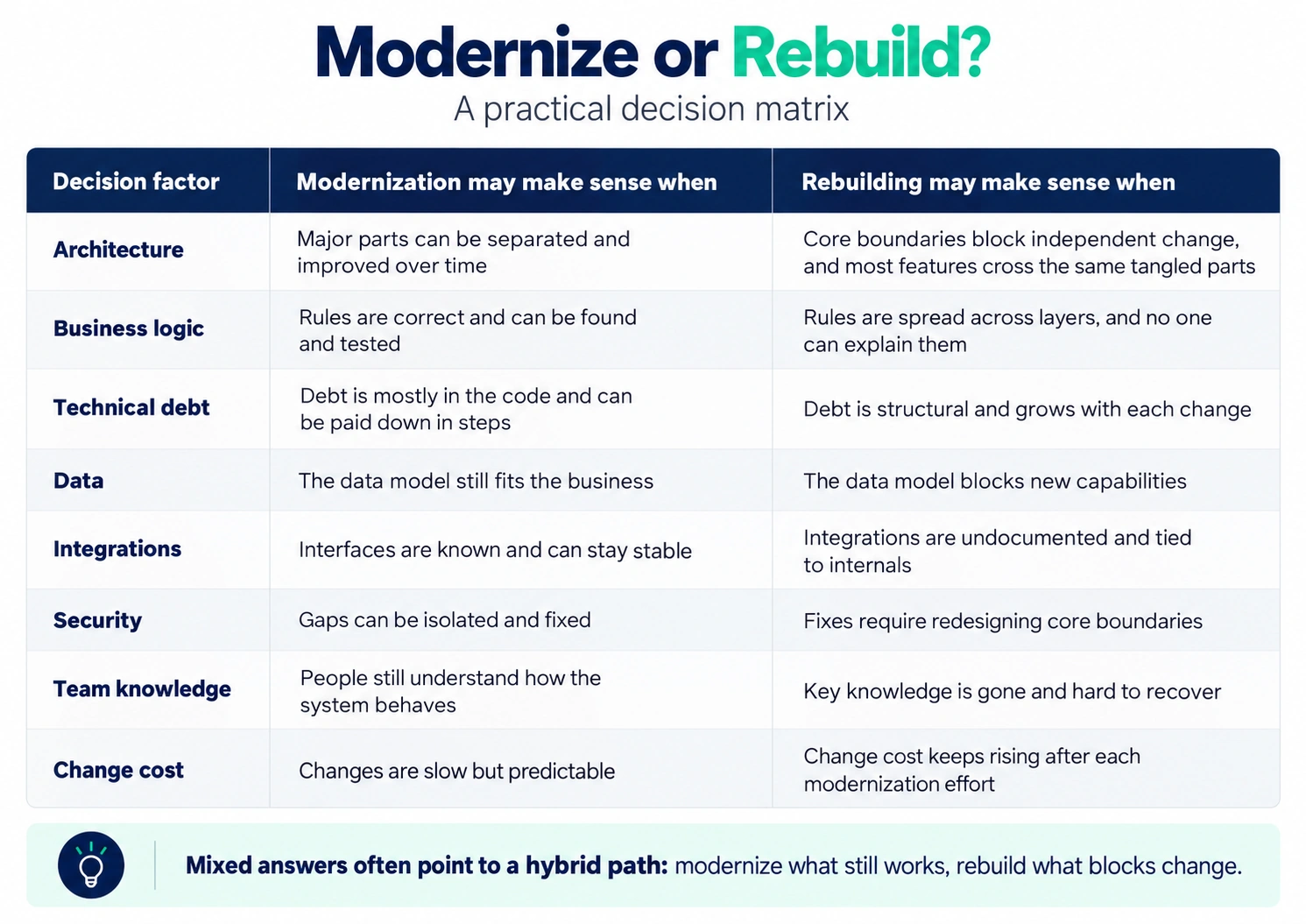
If most answers fall in the right column, a rebuild deserves serious study. Mixed answers point to a hybrid. Modernize what works, and rebuild what blocks change.
How should enterprises make the final decision?
A sound application modernization strategy follows this order:
- Assess the application’s current business value.
- Review the architecture and its structural limits.
- Map business logic and dependencies.
- Separate technical debt from architectural debt.
- Check security, testing, maintainability, data, and technology support.
- Compare both options on transition risk, future change cost, and business needs.
At step six, many teams compare only the starting budgets. A fair comparison also counts data migration, testing, integration changes, and running two systems side by side. It counts the risk of missing hidden behavior and the cost of future changes. A cheap modernization that leaves the system hard to change can lose that comparison. So can a rebuild that takes too long to catch up.
Choose the smallest change that solves the structural problem. Don’t rebuild more than you need to. Don’t preserve more than is still valuable.
Modernize what still has value. Rebuild what prevents change.
Legacy application modernization makes sense when the system still has business and technical value you can improve safely. Rebuilding is the better choice when the architecture itself is the constraint. Keeping it then costs more over time than replacing it.
The goal isn’t to save old software or to replace it. The goal is a system your organization can keep changing safely and at a fair cost.
Not sure which side of the matrix your system falls on? Start with an application modernization assessment. It maps architecture limits, dependencies, technical debt, and transition risk before you commit. ACME One’s application modernization services can help with that assessment and the work that follows.