

Most enterprises should fix their DevOps practices first. Invest in Platform Engineering when the same infrastructure problems show up across many teams.
Platform Engineering does not replace DevOps. It takes DevOps practices that already work and turns them into shared tools. Developers can then use those tools without rebuilding the same pipelines, infrastructure, security controls, and deployment steps each time.
So, the real question isn’t which one is better. It’s where your problems come from. Are your delivery practices weak? Or do good practices break down when many teams try to follow them?
A small team with unreliable CI/CD needs better DevOps. A large company where each product team runs its own deployments, infrastructure modules, and cloud setup may need both.
The answer depends on a few things. How complex are your systems and your cloud setup? How often do developers get stuck? How much infrastructure work gets repeated? And how mature are your delivery practices today?
Platform Engineering vs DevOps: What’s the actual difference?
DevOps is a way of working. Platform Engineering gives many teams a shared way to follow it.
DevOps brings development and operations closer together. Teams share the work of building, releasing, monitoring, and running software. Common practices include version control, automated testing, CI/CD, infrastructure as code, observability, and fast feedback.
Platform Engineering builds shared tools for development teams. These usually come through an internal developer platform. It offers approved workflows, infrastructure templates, automation, security controls, and Golden Paths.
DORA describes Platform Engineering as building internal platforms that help developers work faster and ship software with less complexity.
The CNCF Platforms White Paper says something similar. A platform gives developers what they need without making every team learn every infrastructure detail.
Put simply:
DevOps defines how teams build and run software. Platform Engineering makes those practices easier for many teams to follow the same way.
Why are enterprises moving toward Platform Engineering?
The problem usually shows up as engineering teams grow.
Giving teams more ownership helps. But it also means each developer needs to know more about infrastructure.
A developer who just wants to build a feature may end up needing to understand cloud networking, infrastructure as code, containers, CI/CD tools, secrets management, observability, security policies, and deployment controls.
That’s a lot to keep in your head. Engineers call this cognitive load.
The CNCF Platforms White Paper talks about this directly. When teams own more, they also take on more of the systems that support delivery.
At enterprise scale, a few pressures make this harder.
Cloud setups get complex
Many accounts, environments, regions, services, and sometimes several cloud providers mean more infrastructure decisions.
Tools get fragmented
Teams may pick different CI systems, deployment methods, infrastructure modules, and monitoring setups.
Standards Drift
Security scanning, logging, access controls, and deployment rules may differ from team to team.
Ops teams become bottlenecks
Developers file tickets for environments, access, networking, databases, and routine changes. Then they wait.
DORA’s Platform Engineering research also links platform quality to how much value teams get from AI assisted software development. Writing code faster doesn’t help much if testing, security review, deployment, and infrastructure are still slow.
This doesn’t mean every company needs a platform team. It means the systems around coding matter more as teams speed up and grow.
When is DevOps still enough?
DevOps may be enough when teams can build, test, deploy, and run software reliably without waiting on a central infrastructure team.
A platform has its own cost. Someone has to build it, maintain it, document it, support it, and improve it. If there’s little repeated work to remove, that cost may not pay off.
DevOps may still be enough when:
Your engineering team is fairly small
A few teams using similar tools can often get by with shared CI/CD templates, infrastructure modules, and clear docs.
Your delivery process already works
Deployments are predictable. Environments are easy to get. Monitoring is in place. Developers aren’t often blocked by infrastructure work.
Your architecture is fairly uniform
If most apps use the same deployment model and infrastructure setup, there’s little complexity to hide.
Your main problems are basic DevOps gaps
Manual releases, flaky tests, poor monitoring, weak infrastructure automation, and messy source control are not Platform Engineering problems.
Fixing those foundations should come first.
DORA’s 2024 Accelerate State of DevOps research found that internal platforms can make individual developers more productive. In some cases, platforms were also linked to lower delivery throughput and change stability.
That doesn’t mean platforms are bad. It means a platform won’t fix weak delivery practices on its own.
If your CI/CD, testing, monitoring, and infrastructure automation are unreliable, a platform can spread those same problems to more teams.
What are the signs you need Platform Engineering?
Platform Engineering starts to make sense when the same infrastructure and delivery problems show up across many teams.
Watch for these signs.
Developers wait for environments
Getting a dev or test environment takes tickets, approvals, network changes, or manual cloud setup.
Teams keep building the same infrastructure
Different teams build their own versions of databases, queues, storage, networking, or pipelines. All of them solve nearly the same problem.
CI/CD has started to drift
Teams copy and tweak pipelines until every service has its own version. Then one security or deployment fix has to be made many times.
Security controls don’t match
Some teams use approved secrets management, scanning, access controls, and logging. Others do it their own way.
Ops teams spend too much time on routine requests
DevOps or cloud engineers turn into a help desk for infrastructure. They stop improving shared systems.
Onboarding takes too long
New engineers spend too much time figuring out which pipeline to copy, how to get access, where logs live, and how deployments work.
Only a few people understand the infrastructure
A handful of senior engineers are the only ones who fully understand the cloud accounts, clusters, networks, deployment workflows, and access policies.
One sign alone doesn’t justify a platform team.
The case gets stronger when several of these problems keep showing up across many teams.
Do you actually need Platform Engineering?
Use this table to find your next step.
| Situation | What it usually means | What to do next |
| Small team, simple infrastructure | Little repeated infrastructure work | Improve DevOps practices |
| Stable, reliable deployments | Your current setup works | Keep improving DevOps |
| Manual releases, weak testing, or little infrastructure automation | DevOps basics are missing | Fix DevOps basics first |
| Each team runs its own CI/CD workflows | Duplicate work and drift | Add shared CI/CD templates |
| Developers wait for environments | Provisioning is a bottleneck | Add self service provisioning |
| Teams keep building similar infrastructure | Reusable modules would save time | Build approved infrastructure modules |
| Security controls differ across teams | Governance gaps | Add shared security controls |
| Complex cloud environment serving many teams | Heavy coordination and cognitive load | Consider Platform Engineering |
| Platform would serve a small group with little repeated work | Cost may outweigh value | Keep things simple |
There’s a useful middle ground here.
You don’t have to jump from basic DevOps to a large internal developer platform.
You can start with one shared pipeline, one environment template, or a set of approved infrastructure modules.
If those remove real friction, you can grow them over time.
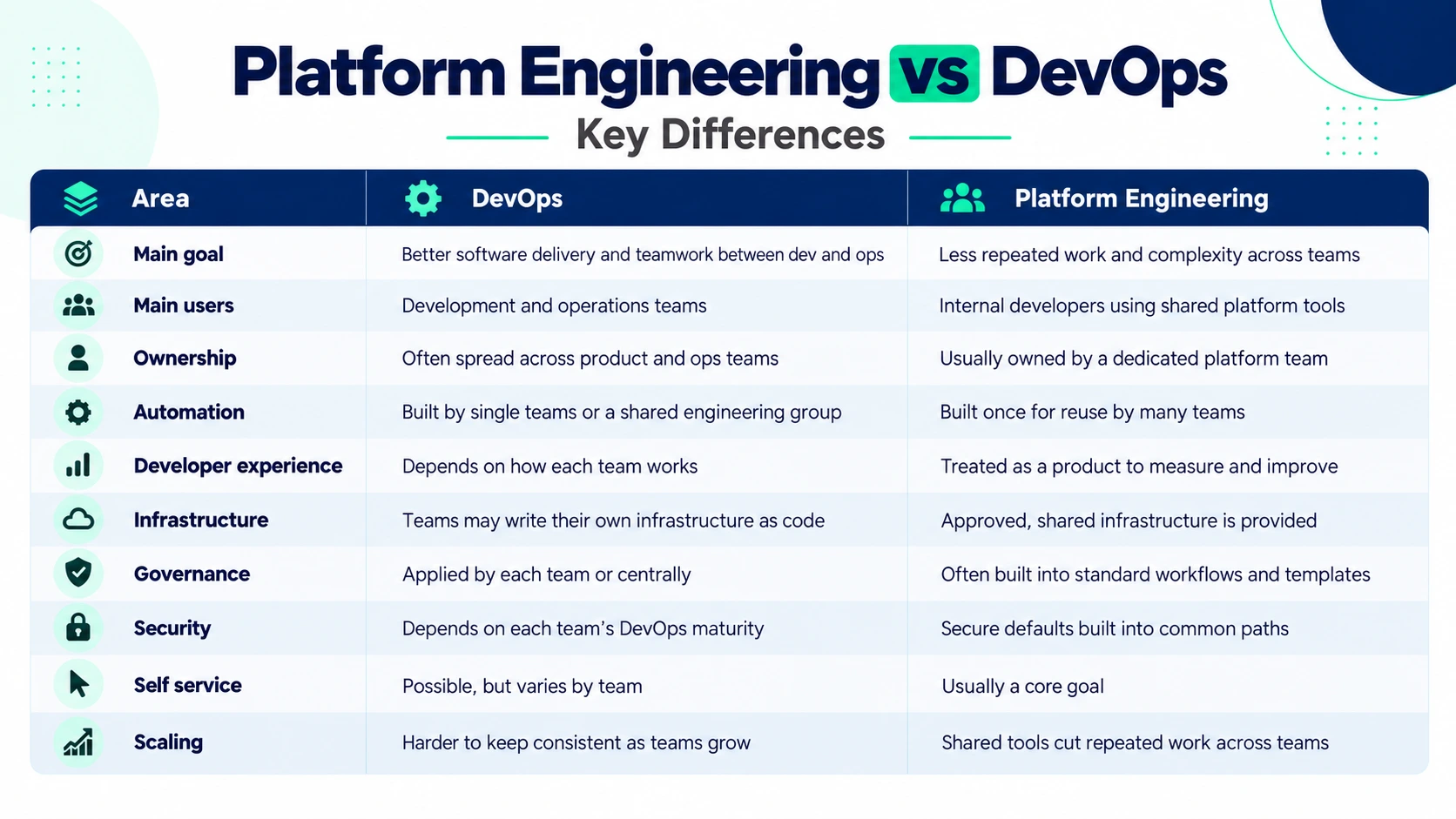
DevOps doesn’t lack automation, self-service, or shared tooling. A mature DevOps team can already have all of these.
Platform Engineering helps when a company deliberately turns those tools into an internal product that many teams can reuse.
Does Platform Engineering replace DevOps?
No. Platform Engineering usually works alongside DevOps.
A Golden Path for launching a new app still relies on automated testing, CI/CD, infrastructure as code, monitoring, deployment controls, and clear ownership.
Those are DevOps practices.
The platform bundles them into a supported path, so teams don’t have to put everything together themselves.
Product teams still own the services they build.
They still need to understand how their apps behave, respond to incidents, monitor production, and fix what breaks.
The platform removes the plumbing. It doesn’t remove responsibility.
What does an internal developer platform actually provide?
An internal developer platform gives developers approved ways to get infrastructure and delivery tools without setting everything up by hand.
Think of it as a set of shared services, not one specific tool.
Depending on the company, it may include:
Environment provisioning
Developers request dev or test environments through a repeatable process.
CI/CD templates
Teams start with approved build, test, security, and deployment workflows. They don’t write every pipeline from scratch.
Infrastructure templates
Reusable modules give approved setups for databases, storage, networking, queues, and other common resources.
Deployment workflows
Teams release, promote, and roll back changes the same way.
Security controls
Scanning, access policies, secrets management, and other controls are built into standard workflows.
Observability
Logs, metrics, traces, and dashboards are ready by default.
Developer portal and service catalog
Developers find services, owners, docs, dependencies, and platform tools in one place.
Documentation
Clear guides explain how to use each supported workflow.
Golden Paths tie these pieces together.
A Golden Path is an approved, supported route for a common task. One example is creating a new service and deploying it to a test environment.
The path should make the normal task easier. It shouldn’t become a rigid rule that blocks teams from making sound technical choices.
The CNCF also notes that platforms can start small. You don’t need a big portal or a major software project at the start.
What should enterprises invest in first?
The right investment depends on where your bottleneck is.
Scenario 1: DevOps foundations are weak
Picture a company where releases are still mostly manual. Test automation is limited. Infrastructure changes are done by hand, and monitoring is patchy.
A platform at this stage just adds another layer on top of shaky foundations.
The better investment is improving DevOps practices.
Automate builds and tests. Move repeatable infrastructure into code. Improve observability. Cut manual deployment work. Set up reliable delivery metrics.
If slow releases come from a tightly coupled legacy app, application modernization may need to come first.
Only after that should you think about turning those practices into shared platform tools.
Scenario 2: DevOps works, but every team does it differently
Picture a growing software company. Product teams can deploy on their own. But each team keeps its own CI/CD pipeline, infrastructure modules, and security setup.
The question is no longer whether DevOps works.
The problem is repeated work and inconsistency.
This is where shared platform tools help.
Start with the tasks teams repeat most. That might be a standard CI/CD template, reusable infrastructure modules, or self-service test environments.
You don’t need a big developer portal on day one.
Scenario 3: Infrastructure complexity affects many teams
Now picture a large enterprise. It has many engineering teams, several cloud environments, strict security rules, and a central cloud team with a growing queue of requests.
Here, a dedicated Platform Engineering team may make sense.
The platform team can treat developers as internal customers. It can build shared tools around the workflows that cause the most friction.
DORA recommends starting with a minimum viable platform. Don’t try to solve every engineering problem at once.
The CNCF guidance also suggests working with a few engaged development teams early. That way, the platform is built around real needs.
DORA describes a J curve during platform adoption. Early gains may be followed by a dip as complexity rises. Results improve again as the platform matures.
Leadership should know this before expecting quick results.
Common Platform Engineering mistakes
Most Platform Engineering failures don’t come from picking the wrong tool.
They come from the wrong operating model.
Renaming the DevOps team
A new team name doesn’t create Platform Engineering.
If developers still file the same tickets and wait for the same manual work, nothing has really changed.
Building without understanding developer problems
DORA warns against the “build it and they will come” approach.
Platform teams should first learn how developers create services, request environments, deploy changes, and fix production issues today.
Then they can see where developers actually lose time.
Becoming another ticket-based operations team
If developers still have to file a request for every platform action, you’ve moved the queue. You haven’t removed it.
Self-service should remove routine dependencies wherever that’s safe and practical.
Overengineering the first release
Launching a full portal, service catalog, multi cloud abstraction layer, and every possible Golden Path at once adds risk.
Start with one small problem that keeps coming up.
Solve it well.
Then expand.
Forcing adoption
A platform should become the preferred path because it saves developer’s time.
The CNCF guidance warns against leaning on top-down mandates.
Teams are more likely to adopt a platform when the supported path is easier than building and maintaining their own.
Creating a Golden Cage
Standards shouldn’t remove all flexibility.
DORA uses the term Golden Cage for a platform that has become too restrictive.
Give teams good defaults. But allow justified exceptions when a workload really needs something different.
Ignoring developer experience
Fast infrastructure doesn’t help much if docs are outdated, errors are unclear, or workflows are confusing.
DORA’s research shows the value of clear feedback on the outcome of developer tasks.
Platform teams should measure the experience, not just the infrastructure.
How do you know Platform Engineering is working?
Platform Engineering is working when developers wait less, use shared tools without constant help, and keep shipping safely.
Take a baseline before you build the platform.
Then track a balanced set of measures, including the DORA software delivery metrics.
| What to measure | Useful metrics | Good direction |
| Developer wait time | Environment setup time, infrastructure request time | Falling |
| Delivery speed | Deployment frequency, change lead time | Steady or improving |
| Delivery stability | Change failure rate, recovery time | Steady or improving |
| Onboarding | Time for a new engineer to ship a first production change | Falling |
| Ops load | Routine infrastructure ticket volume | Falling |
| Platform adoption | Use of approved templates and shared tools | Growing without mandates |
| Developer experience | Surveys and direct feedback | Improving |
Don’t rely on one metric.
For example, fewer tickets look good. But if developer satisfaction drops too, teams may just be avoiding the platform and building workarounds.
DevOps, Platform Engineering, or both?
For many growing enterprises, the path is step by step.
Start with good DevOps practices. Add shared tools when repeated work appears. Build a dedicated platform team when that complexity starts affecting many teams.
Three questions can show where you are now.
1. Are your delivery foundations reliable?
If CI/CD, automated testing, infrastructure as code, monitoring, and deployment practices are still weak, improve DevOps first.
2. Are several teams solving the same infrastructure problems on their own?
If yes, build shared tools for the tasks teams repeat most.
3. Has infrastructure complexity become a companywide bottleneck?
Do developers often wait on cloud or DevOps teams? Is it hard to keep security, governance, and delivery standards the same across teams? If so, Platform Engineering may be worth the investment.
If you answered no to the second and third questions, you may not need Platform Engineering yet.
That’s a valid decision.
Revisit it as your teams, cloud setup, compliance needs, and software portfolio grow.
Are your developers rebuilding the same infrastructure, waiting for environments, or working around messy delivery processes? Then it’s worth reviewing your setup. A review can show whether better DevOps practices, shared platform tools, or a dedicated platform team should come next.
Conclusion:
ACME One’s Platform Engineering services help engineering teams find these bottlenecks and build shared tools around the problems that actually slow development. For examples of related work, see how ACME One moved Herbalife’s on premises infrastructure to Azureandautomated internal workflows with Azure Runbooks.