Fintech software development services help financial businesses create digital systems. These systems support secure transactions and services. The technologies can support payments, transactions, and financial data. The appropriate partner delivers simple products along with strong security. Compliance is built in from the start.
The process of balancing these priorities can be tough. US fraud losses reached $15.9 billion in 2025. This case is increasing demand for safer fintech apps. That’s why the way you build your financial software matters so much. This guide covers fintech growth, costs, compliance, and partner selection.
Why Are Fintech Solutions Now a Growth Priority in the US?
The fintech market continues to grow at a good pace. The global fintech market was valued at $394.88 billion in 2025.
Customer expectations drive much of that growth. People want instant payments, clear account views, and approvals in minutes. Companies that fall behind risk losing customers.
Risk is climbing too. For any business that handles money, strong fintech security isn’t a nice extra. It’s a core product feature.
How Does Fintech Software Help Business Growth?
Fintech software reduces costs and speeds up payments and approvals. This software can also unlock new revenue opportunities and improve decision-making. These gains build on each other. Lower costs free up budget, and a better experience brings in more customers.
Faster, Cheaper Transactions
Payment processing software automates routing, reconciliation, and settlement. This processing is done while reducing hours of manual finance work. Fewer manual steps reduce errors and chargebacks.
New Revenue Through Embedded Finance
Many nonbanking businesses now offer built-in financial services. These include payments, instant payouts, financing, and small business loans. Custom fintech software aligns financial features with your brand and data for a smoother customer experience.
Scalable Fintech Solutions for Growing Businesses
Growth breaks weak systems. Cloud systems let businesses scale without rebuilding the entire platform. That separates scalable fintech solutions from short-term builds.
Better Decisions From Better Data
Financial software development today includes analytics and AI. Reliable data improves credit, fraud detection, and forecasting.
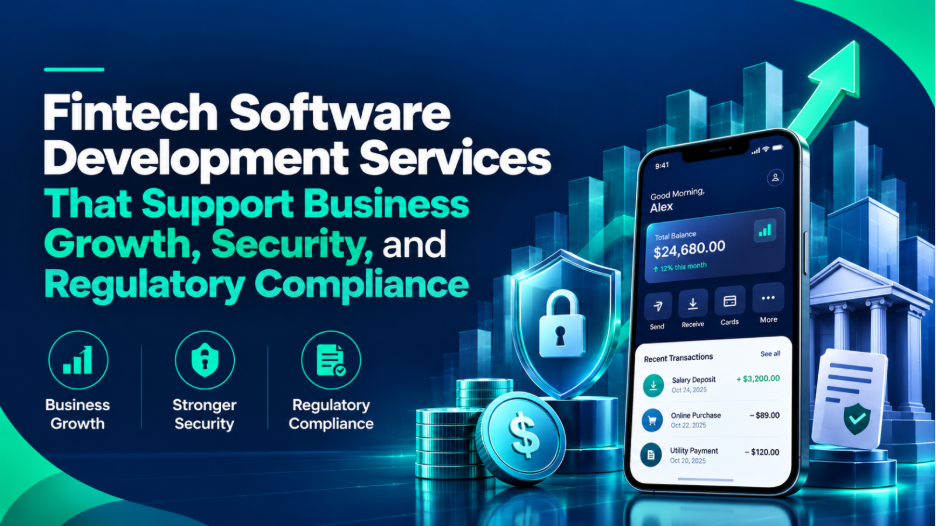
What Do Fintech Software Development Services Include?
Successful fintech projects combine multiple services under one plan. The strongest fintech software development services for businesses cover the full product life cycle:
Fintech consulting and development services:
Define the product, compliance needs, and system architecture before development starts.
Fintech application development:
Secure mobile and web apps for banking, investing, budgeting, and lending.
Payment processing software:
Gateways, digital wallets, merchant dashboards, and reconciliation tools.
Financial systems integration:
Connecting banking, payment, KYC, accounting, and open banking systems for reliable data flow.
Regtech and compliance tools:
AML monitoring, audit tracking, and automated compliance reporting.
Ongoing support:
Tracking, patching, performance tuning, and new feature releases.
Financial app development is an ongoing process. Plan for changes in regulations, customer needs, and fraud risks. Good fintech technology solutions are built to adapt.
Fintech Security: Protecting Financial Data From Day One
Security failures can be costly for financial firms. The average reached a record $10.22 million for US organizations across all industries.
NIST Cybersecurity Framework 2.0 provides a baseline for these controls. This framework aligns risk management while creating customer trust and supporting growth.
How Do Fintech Companies Meet Regulatory Requirements?
Fintech companies meet requirements by building compliance into their products. These companies prove compliance through audits, logs, and documentation. The table below covers the frameworks US fintech teams run into most often.
| PCI DSS v4.0.1 | Card payment data | Encryption, access control, logging, and regular vulnerability scans for systems that touch card data |
| GLBA Safeguards Rule | Customer financial information | A written security program, risk assessments, and FTC notice for breaches affecting 500 or more consumers |
| BSA/AML | Money laundering and terrorist financing | KYC checks, transaction monitoring, and suspicious activity reports to FinCEN |
| SOX | Financial reporting at public companies | Audit trails, change control, and access reviews for systems that affect reported numbers |
| CCPA/CPRA | California consumer privacy | Data mapping, consent tracking, and tools to handle access and deletion requests |
| NYDFS Part 500 | Cybersecurity for New York regulated firms | Multifactor authentication, a named CISO, incident reporting within 72 hours, and annual certification |
| SOC 2 | Service provider controls (voluntary) | Independent proof that security and availability controls work as described |
How Much Does Fintech Software Development Cost?
Fintech software can cost $50,000 to $500,000 or more. These costs are based on scope, security, integrations, and compliance. A focused MVP costs less. Platforms with various products, strong security, and many integrations cost more.
| Project Type | Typical Scope | Estimated Cost | Timeline |
| MVP or proof of concept | Core features, one platform, basic integrations | $50,000 to $150,000 | 3 to 5 months |
| Mid-size fintech app | Web and mobile, payments, KYC, analytics dashboard | $150,000 to $350,000 | 5 to 9 months |
| Enterprise platform | Multiple products, core banking integration, advanced fraud and compliance tools | $350,000 to $1,000,000+ | 9 to 18 months |
| Ongoing support | Monitoring, updates, security patches | 15% to 25% of build cost per year | Ongoing |
The biggest cost drivers are:
- Complexity of banking, payment, and data integrations.
- Compliance needs, especially for card data or multi-state operations.
- Security testing, penetration tests, and third-party audits.
In-House, Outsourced, or Hybrid: Which Team Model Fits?
After setting the budget, choose your development team. Some companies build their fintech team by hiring developers in-house. Others outsource fintech software development to a specialist partner. Many do both.
| Factor | In-House Team | Outsourced Partner | Hybrid (Staff Augmentation) |
| Time to start | 3 to 6 months to hire | 2 to 4 weeks | 2 to 6 weeks |
| Upfront cost | High (salaries, benefits, recruiting) | Moderate, project-based | Moderate |
| Fintech experience | Depends on each hire | Strong if the partner specializes | Mixed |
| Roadmap control | Full | Shared, set by contract | High |
| Ability to scale | Slow | Fast | Fast |
| Best for | Long-term core products | New builds with fixed scope and deadlines | Growing teams with skill gaps |
An outside fintech team can best meet the first build. As the product grows, an internal team takes over long-term ownership.
How Do I Choose a Fintech Software Development Company?
Select a fintech partner with relevant experience, good security practices, and transparent pricing. You can ask for evidence on each point before you sign.
Domain experience:
You can look for practical experience with fintech products and financial systems.
Security practices:
Check for SOC 2 or ISO 27001, secure coding, and regular testing.
Compliance knowledge:
The team should discuss PCI DSS, GLBA, and AML with confidence.
Integration track record:
Financial integrations can delay development. You can ask about experience with banking, payment, and KYC systems.
Clear process:
Expect discovery, regular demos, and full ownership of your code and IP.
Support after launch:
Check support timelines, service commitments, and the process for security updates.
A strong fintech partner should improve ideas.
Check how the partner plans and begins the project. ACME One maps compliance needs before completing the structure. You can choose a partner that addresses compliance and risk from the start.
Final Thoughts
The best fintech software development services don’t treat growth, security, and compliance as separate goals. They plan for all three from the start. This technique lowers costs, speeds up audits, and creates customer trust.
You can start with a clear scope. Make sure to plan your regulatory obligations early. Then choose a partner with proper financial domain experience. With the appropriate setup, fintech solutions can support growth. They can do so while reducing risk.
Clear answers lead to an authentic budget and timeline. Future fintech leaders do not become successful by just selling more features. Customers will trust them if they meet their requirements. Choose fintech solutions and partners that put trust first.