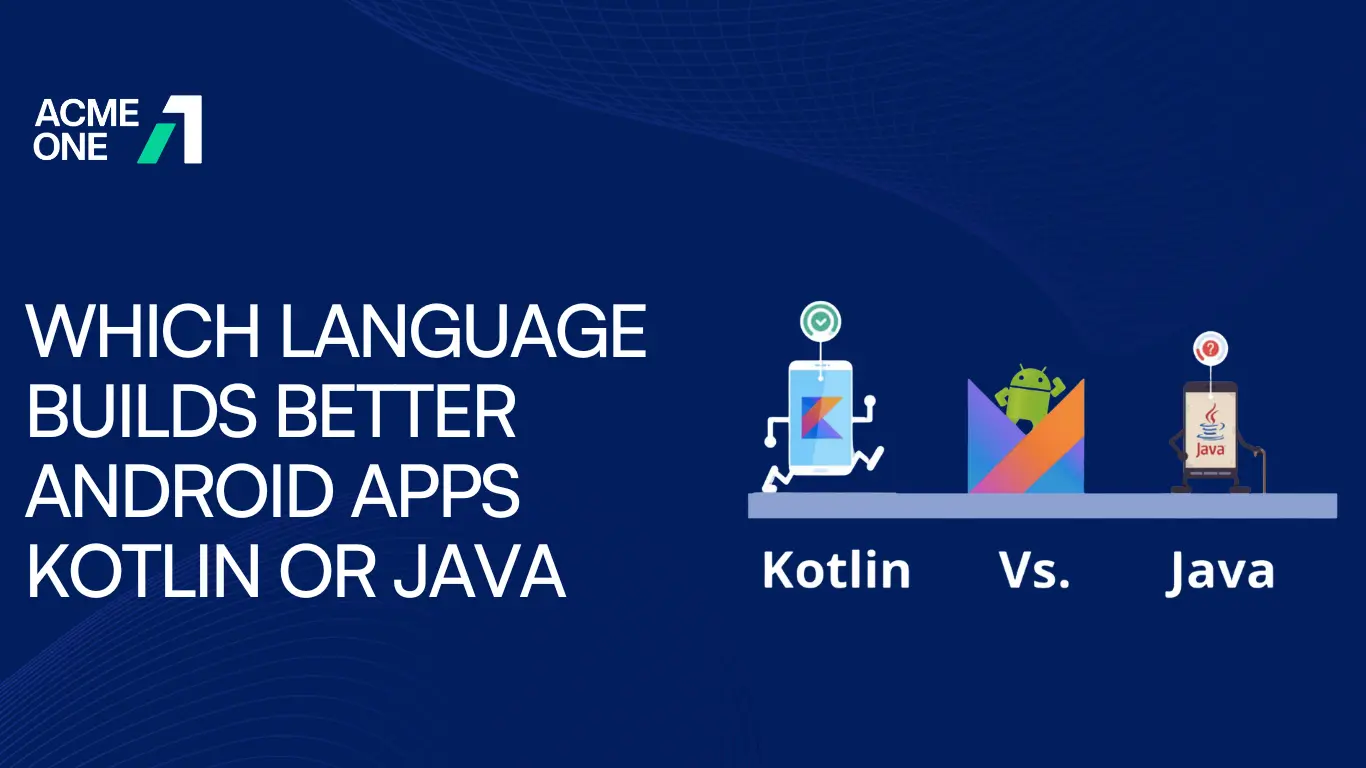
There seem to be countless arguments between Kotlin and Java regarding Android app development. These two languages have been at the forefront of Android development, each with its legion of supporters and a list of pros and cons. But today, we’re diving deep to settle the debate: Kotlin vs. Java, which one reigns supreme?
Let’s discuss in this blog the Kotlin vs Java for Android development. We will be demonstrating their benefits, uses, and which one is the most suitable fit.
Background
Java has been the foundation of Android app development since its establishment around the mid 90s. Kotlin is the newcomer, introduced in 2011 by JetBrains. Kotlin is popular for its modern, compact syntax.
Kotlin vs Java Comparison
Let’s put these two competitors in a table to compare their core features:
Feature | Kotlin | Java |
Syntax | Concise and expressive | More verbose |
Null Safety | Built into the language | Requires manual checks |
Extension Functions | Supported natively | Requires utility classes |
Asynchronous Programming | Coroutines built in | External libraries are often required |
Learning Curve | Moderate for Java developers | Familiar to most developers |
Interoperability | Fully interoperable with Java | Not applicable |
Compilation Performance | Comparable in most cases | Can be slower in large projects |
Developer Experience and Productivity
From practical world Android projects, many teams report that Kotlin reduces generic text/code and common failures, particularly those related to null references. Kotlin’s concise syntax often leads to improved readability.
Java remains creative in mature codebases where tooling and team expertise are already established. For teams with long-term Java experience, productivity can remain very high without introducing a new language.
When is Java the Right Choice?
- Maintaining or extending large legacy Android applications.
- Projects that rely heavily on existing Java libraries.
- Teams with deep Java expertise and limited time for training.
- Environments where long-term stability is emphasized over rapid iteration.
When is Kotlin the Suitable Fit?
- Starting new Android projects
- Prioritizing developer productivity and code safety
- Reducing common runtime errors, such as null pointer exceptions
- Building modern Android architectures with cleaner code
Official Support and Industry Adoption
Google’s support for Kotlin resulted in it being the main language for Android development. Kotlin is now widely used in new Android projects and is supported across Android Debug Bridge, libraries, and documentation. At the same time, Java remains fully supported and continues to power a great portion of Android applications in production today.