

In 2013, our client, a general insurance provider with a great presence in automobile and trailer insurance, faced pressure in a slowing market. Specialty insurers were attracting niche customer segments with more personalized offerings, while traditional motor insurance products were losing their flow.
By early 2014, the company saw its gross profit margin drop by 7 percent in Q1 and 9 percent in Q2. A significant number of insured vehicles were reporting above average accident ratios. In some cases, margins had fallen as low as 2 percent per year.
Leadership realized that the traditional flat premium model was no longer suitable. They needed a way to differentiate customers based on risk and reward safe drivers, but they lacked the technology to track driving behavior at an individual level.
The business problem was clear. The technology path was not.
The client wanted to:
However, several gaps stood in the way.
They had historical accident statistics, but no system to monitor drivers in real time. There was no method to collect, store, and analyze individual driving behavior data. Without that visibility, launching usage based insurance products was not possible.
The company needed an authentic way to observe driving behavior continuously and convert raw vehicle data into meaningful risk insights.
The primary goal was to build a real time driver monitoring system that could support new insurance models.
The objectives included:
The broader aim was to move from reactive claim management to proactive risk management.
After evaluating the client’s needs, Acme One designed a telematics driven solution powered by cloud infrastructure and big data processing.
We selected Danlaw’s Data Logger device, which connects to the vehicle’s OBD II port. The device collects driving data and transmits it through smartphone Bluetooth over 3G and 4G GSM networks to the cloud.
Raw data was stored in Amazon Web Services, specifically AWS S3. Microsoft Azure was used to manage and process tracked data and deliver insights to the client’s systems.
Windows Services and Microsoft .NET framework were used to parse and transform raw telematics data into structured, modeled datasets. The processed data was stored in SQL databases for reporting and scoring purposes.
We developed an algorithm to calculate an overall driver score based on parameters such as:
This score enabled risk categorization of drivers into low risk and high risk groups.
The processed data was displayed on a dashboard at the client’s end. The interface provided real time visibility into driving routes, trip history, fuel consumption, and behavioral statistics.
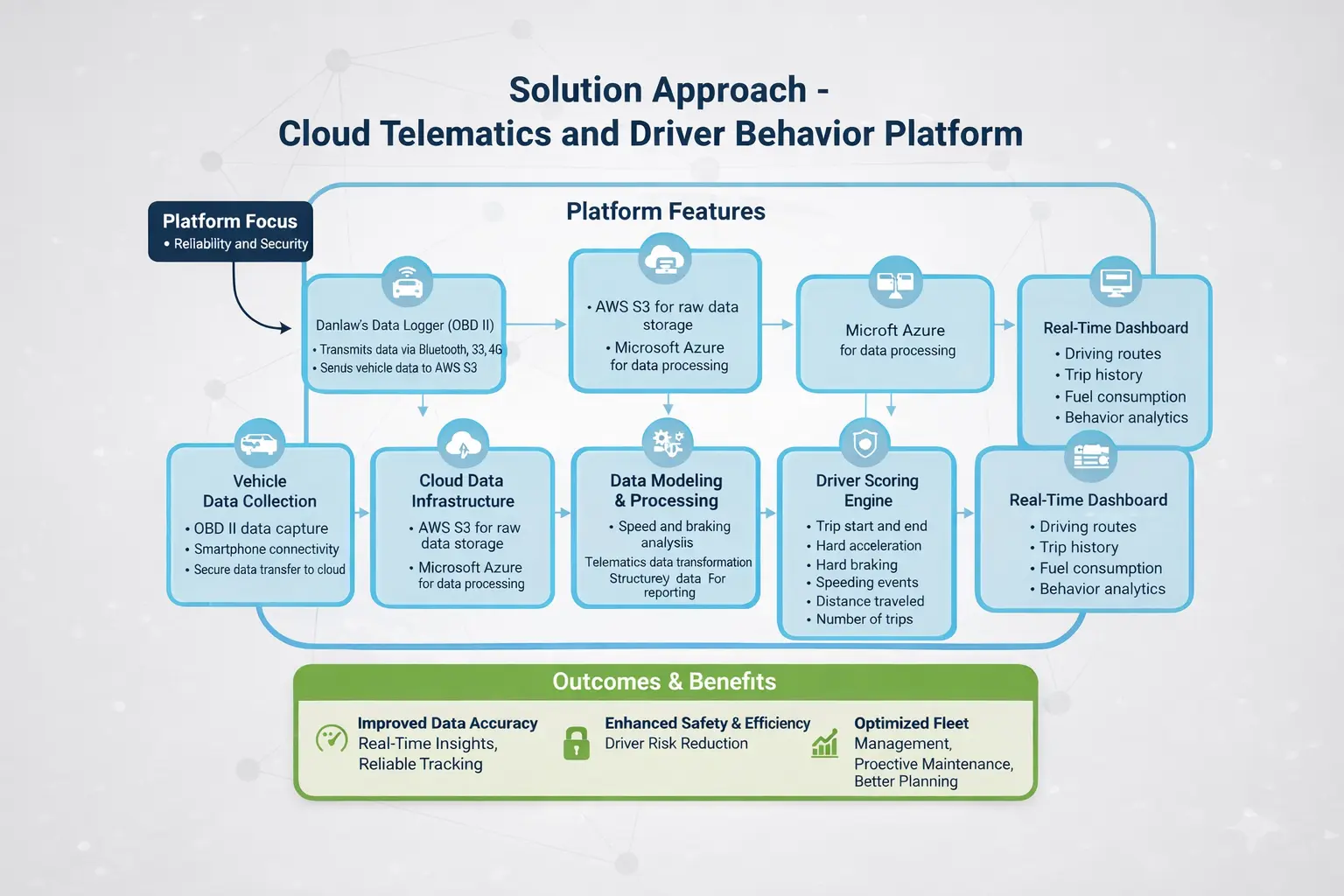
The solution was built using:
One of the most complex tasks was converting raw AWS data into structured models suitable for scoring and visualization. This challenge was addressed through custom parsing and transformation logic built using .NET.
Don’t just take our word for it. Hear what our satisfied clients have to say about their experience partnering with ACME ONE



We’re here to help! If you have any questions or would like to discuss.
We’re here to help! If you have any questions or would like to discuss how our IT services and technology solutions can benefit your business,
Meydan – Nad Al Sheba – Dubai – United Arab Emirates
+971 50 952 6681
info@acme-one.com
Monday - Friday: 9.00 - 6.00
Saturday & Sunday (Closed)
We’re here to help! If you have any questions or would like to explore how our custom software, digital solutions, and IT expertise can support your business growth.