Blockchain has moved past the hype phase. Qatar and Gulf enterprises are adopting blockchain across key industries. Qatar National Vision 2030 promotes secure, data-driven systems that support a knowledge economy.
Your blockchain platform will shape cost, performance, and compliance. It will also affect scalability and speed to market. This guide compares leading enterprise blockchain platforms for scale. It also answers key questions from technology leaders in Doha.
What Is Enterprise Blockchain, and Why Does It Matter Now?
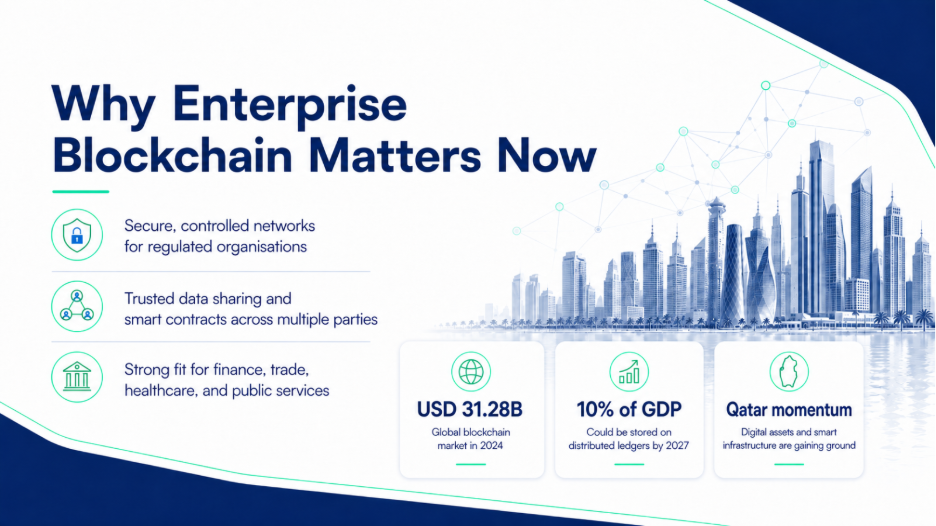
Enterprise blockchain provides secure, controlled networks for regulated organizations. It lets verified participants transact, share data, and run smart contracts securely. This control makes enterprise blockchain suitable for regulated industries and public services.
The commercial case is getting harder to ignore. Grand View Research valued the global blockchain market at about USD 31.28 billion in 2024. Gartner identifies blockchain tokenization and asset digitization as key trends for CIOs. The World Economic Forum estimates that 10% of global GDP could be stored on distributed ledgers by 2027.
For Qatar, the appetite is real. Qatar is advancing digital assets through QCB and QFC initiatives. MCIT is also supporting smart infrastructure projects. Regulatory clarity gives enterprises confidence to adopt blockchain at scale.
How to Evaluate Enterprise Blockchain Platforms?
Before you compare vendors, agree internally on what matters. Most enterprise buying teams weigh these factors:
- Transaction speed and settlement efficiency.
- Privacy controls for secure data access and handling.
- Governance for network control, rules, and upgrades.
- Smart contract support across key programming languages.
- Integration with existing ERP, core banking, and identity systems.
- Compliance with local and global regulatory requirements.
- Total cost of ownership across licensing, node operations, and audits.
Top Enterprise Blockchain Platforms in 2026
Hyperledger Fabric
Hyperledger Fabric is a widely adopted permissioned blockchain for banking and supply chains. It offers privacy, flexible consensus, and identity controls for regulated environments in Qatar. Fabric has powered TradeLens, Food Trust, and Gulf trade finance networks.
R3 Corda
R3 Corda was built specifically for financial services. Its point-to-point model reduces data exposure and improves settlement speed. Corda supports tokenized deposits, digital bonds, and trade finance for financial institutions.
Ethereum Enterprise (Consensys Quorum and Besu)
Ethereum offers a large developer ecosystem with permissioned enterprise options. Hyperledger Besu and Consensys Quorum offer private transactions, IBFT consensus, and EVM compatibility. If you want interoperability with public Ethereum or Layer 2 networks later, this is a safe path.
Hedera
Hedera uses hashgraph consensus but is often grouped with enterprise blockchain platforms. It delivers high transaction speeds, predictable fees, and council-based governance. Hedera has become popular for tokenization, carbon markets, and identity use cases.
Polygon (CDK and Supernets)
Polygon’s Chain Development Kit lets enterprises create custom chains. They can still benefit from Ethereum’s security. It suits consumer blockchain apps, loyalty programs, and tokenization. It works well where speed and low costs matter.
IBM Blockchain Platform on Hyperledger Fabric
IBM managed blockchain offering wraps Fabric in enterprise support, cloud tooling, and integration accelerators. For organizations already on IBM Cloud or looking for a single vendor of record for procurement, it shortens time to production.
Enterprise Blockchain Platform Comparison
The table compares leading blockchain platforms for scalable business applications. Numbers are indicative and vary by network configuration.
| Platform | Type | Throughput (TPS) | Consensus | Best For |
| Hyperledger Fabric | Permissioned | 1,000 to 3,000+ | Raft, BFT | Supply chain, trade finance, healthcare |
| R3 Corda | Permissioned | 600 to 1,700 | Notary based | Banking, capital markets, insurance |
| Ethereum Enterprise | Permissioned or hybrid | 500 to 2,000 | IBFT, QBFT | Smart contracts, tokenization, DeFi bridges |
| Hedera | Public permissioned | 10,000+ | Hashgraph aBFT | Tokenization, ESG, high volume payments |
| Polygon CDK | Layer 2 or app chain | 2,000 to 65,000 | PoS, zk rollup | Consumer apps, gaming, loyalty, NFTs |
| IBM Blockchain (Fabric) | Managed permissioned | 1,000 to 3,000+ | Raft | Regulated enterprises on IBM Cloud |
A quick note on the numbers. Throughput depends on hardware, block size, policies, and on-chain data volume. Treat the figures as directional, then validate them in a proof of concept against your own workload.
Where Enterprise Blockchain Fits in Qatar’s Economy?
Qatar’s key sectors, including energy, finance, logistics, and tourism, have strong blockchain use cases.
Banking and Payments
Local banks are exploring tokenized deposits, cross-border settlements, and blockchain-based trade finance. The Qatar Central Bank’s CBDC pilot signals that regulated digital money is on the roadmap, not just a research topic.
Ports, Logistics, and Trade
Hamad Port handles a large share of Qatar’s non-oil trade. Shared ledgers cut paperwork, reduce disputes, and speed up customs clearance. Blockchain can unify port, customs, trade, and payment workflows in one trusted system.
Energy and Sustainability
Blockchain can track carbon credits and LNG cargo provenance. It can also simplify joint venture reconciliation. Hedera and Fabric are both being used globally for these workloads.
Government and Identity
Digital identity, credential verification, and public procurement all benefit from tamper-evident records. Qatar Digital Government creates opportunities for blockchain-based shared services.
Choosing the Best Enterprise Blockchain Platform for Your Business
There is no single winner. The right blockchain platform depends on the business need. Banks, logistics firms, and health authorities require different solutions. A simple framework helps shortlist the best enterprise blockchain platforms.
- If privacy between counterparties is critical and volumes are modest, start with Corda or Fabric.
- If you need a rich developer ecosystem and future public network optionality, go with Ethereum Enterprise or Polygon CDK.
- If throughput and predictable fees matter most, evaluate Hedera.
- If procurement prefers a managed service with a named vendor, IBM Blockchain Platform shortens the path.
Whichever direction you pick, plan for integration early. Blockchain projects often fail when identity, data, and API layers are poorly planned. ACME One helps Qatar enterprises connect legacy systems with blockchain infrastructure for production.
Common Risks and How to Manage Them
Enterprise blockchain solutions still carry real risks. Governance disputes, key management failures, and smart contract bugs are the top three we see in post-mortems. Independent audits and clear upgrade processes reduce key risks. Hardware-backed key custody adds stronger security. Qatar’s privacy law requires sensitive data to stay off-chain, with only proofs stored on the ledger.
Final Remarks
Enterprise blockchain adoption in Qatar is entering a more mature phase. Clearer regulations, managed nodes, and proven platforms now support blockchain at scale. Leaders must choose a blockchain platform that fits strategy, regulations, and existing systems.
Successful blockchain projects in the region tend to follow three common principles. They focus on a clear business need from the start. They choose blockchain platforms based on data residency, performance, and governance needs. They give equal focus to integration, identity, and adoption. This approach helps turn blockchain pilots into valuable production systems.