Boardrooms across Riyadh, Jeddah, and Dammam are asking the same question that keeps executives in London and New York awake at night. Where does generative AI actually pay back? The pilots are done. The demos have been watched. Now, finance teams want numbers, and CIOs want deployments that survive in contact with real workloads.
This guide covers generative AI applications helping Saudi enterprises achieve measurable results under Vision 2030. Identify the best AI opportunities and build a plan for measurable results.
Why Enterprises Are Betting on Generative AI?
Generative AI moved from curiosity to a line item in less than three years. McKinsey estimates generative AI could add US$2.6 to US$4.4 trillion annually to the global economy.
For enterprises in Saudi Arabia, the pull is still stronger. Saudi Vision 2030 and the national digital agenda place AI at the center of economic diversification. National AI strategy targets have set the country on a path to become one of the top data and AI economies in the world. That means real budget, real projects, and real pressure to deliver returns.
Enterprise generative AI is not a single product. It combines AI models, enterprise data, and guardrails to support business tasks.
How Does Generative AI Improve ROI?
Return on investment from generative AI shows up in four places. Cost reduction through automation of repetitive knowledge work. Revenue lift through better customization and faster sales cycles. Risk reduction through improved detection and compliance monitoring. Speed to market through faster software delivery and content production.
The pattern that separates winners from expensive pilots is a narrow scope. Teams that pick one process, measure a baseline, implement AI automation solutions against it, and report the delta are the teams that get funded for phase two. Teams that try to be overly ambitious tend to ruin their credibility instead.
Top Generative AI Applications with Measurable ROI
The following applications have moved past the hype stage. Each one has production deployments in banks, hospitals, energy firms, and government entities across the region and beyond. Each one has a clear path to measurable ROI.
Intelligent Document Processing and Automation
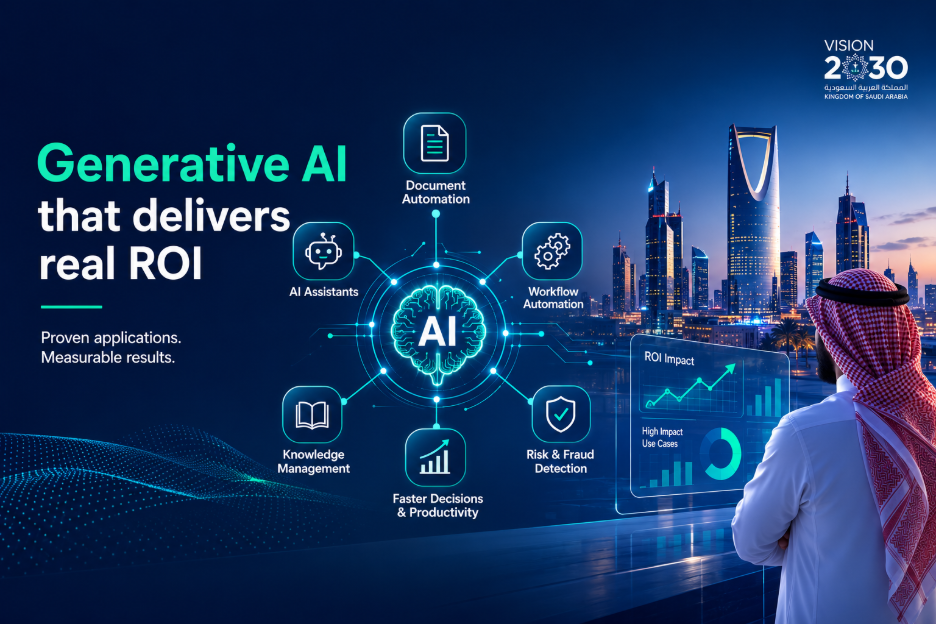
Every large enterprise fails in its documents. Contracts, invoices, claims, KYC packets, medical records, and engineering drawings. Generative AI for document processing and automation reads these files, extracts structured data, classifies them, and routes them to the right team. It also drafts summaries and flags anomalies for human review.
A regional bank using AI applications for onboarding can typically cut document review time by 60 to 80 percent, according to figures published by the World Economic Forum on AI in financial services. The savings compound faster because faster onboarding also lifts the conversion of new customers.
AI Assistants for Employees and Customers
AI assistants have moved from novelty chatbots to serious productivity tools. Internally, they answer HR and IT questions, help engineers navigate documentation, and support call center agents in real time. Externally, they handle tier-one customer queries in Arabic and English, escalate cleanly, and reduce average handle time.
For Saudi enterprises serving bilingual customers, dialect handling matters. Modern foundation models now support Modern Standard Arabic and several Gulf dialects with production quality, which changes the economics of contact center automation.
AI Workflow Automation
Interesting work happens when generative AI is placed into existing systems. AI workflow automation combines language models with process management so that an email, a document, and a database record can flow through a series of decisions without a human touching each step.
Examples include automated tender response drafting, procurement request triage, and expense report validation. The ROI is usually a mix of hours saved and errors avoided, and it is the fastest area to show finance a clean payback.
AI Knowledge Management
Enterprise knowledge management has always been broken. Wikis go obsolete. SharePoint becomes a graveyard. Generative AI fixes these issues by treating internal documents as a live collection, while answering questions with citations, and highlighting when sources disagree.
For engineering, legal, medical, and consulting teams, AI knowledge management is often the first application to earn universal love from users. That user love converts to adoption, and adoption is what produces ROI.
Code Generation and Software Modernization
Software teams using AI coding assistants report productivity increases in the 20 to 45 percent range, with the highest gains on routine tasks like unit tests, refactoring, and standard. For enterprises modernizing legacy systems, AI can also translate old codebases, document undocumented modules, and enhance transfers to cloud native platforms.
Marketing and Content Personalization
Generative AI produces campaign copy, product descriptions, and personalized offers at a scale that is not achievable by manual teams.
Fraud Detection and Risk Analysis
Language models are excellent at spotting patterns in unstructured signals. Emails, chat logs, transaction narratives, and support tickets all carry hints that pure numeric systems miss. Financial institutions across the region are associating generative AI with existing rules engines to catch fraud earlier and reduce false positives, which lifts customer experience as well as loss ratios.
How Much ROI Can Generative AI Deliver?
It depends on what you automate and how well you measure. Public case studies from banks, insurers, and telcos show payback windows of six to eighteen months for clearly-defined projects. Productivity gains in white-collar roles range from 10 to 40 percent based on the task.
Gartner predicts generative AI will become a standard feature in enterprise applications by 2026. Enterprises that wait risk paying more later, both for talent and for catch-up integration work.
Saudi Arabia's Vision 2030 and the Enterprise AI Opportunity
Saudi Arabia's national ambition around AI is one of the most effective globally. Saudi AI policy, national strategy, and giga projects are driving AI transformation at scale. Add the Kingdom's Personal Data Protection Law and the growing emphasis on sovereign cloud, and the picture is clear. Saudi enterprises need generative AI solutions that respect data residency, support Arabic content, and merge with local systems.
This is where custom generative AI solutions and enterprise generative AI services obtain their place. Off-the-shelf tools often stop at the language barrier or the compliance boundary. A well-designed AI platform unifies models, data, guardrails, and combinations for local use.
Choosing the Right Enterprise AI Platform
Selecting a platform is less about the model and more about the operating model. Ask three questions. Where does our data live, and who can see it? Which processes will pay back in the first year, and which are longer plays? Do we have the internal skills to run this, or do we need a partner?
Generative AI consulting services help enterprises answer those questions. A good partner will start with a value assessment, pick two or three high probability use cases, and prove the numbers before expanding. ACME One works with enterprises across the Gulf on exactly this kind of engagement, from AI strategy through to production deployment.
Data readiness first: Clean, well-governed data drives model quality more than any prompt technique.
Data readiness first:
Clean, well-governed data drives model quality more than any prompt trick.
Human in the loop by design:
Every high-stakes workflow needs a review step, not just a log file.
Measure baselines before deployment:
Without a baseline, ROI claims are marketing, not accounting.
Plan for change management:
The tool is the easy part. Adoption is the work.
Final Remarks
Generative AI applications are no longer an experiment. It is a working part of how modern enterprises reduce cost, improve service, and speed up delivery. The organizations pulling ahead are the ones treating it like any other operational capability. They pick the right process, measure a baseline, put the right guardrails in place, and hold the deployment to a real number.
For Saudi enterprises, the window is open. Vision 2030 has cleared the runway on policy, funding, and demand. What remains is execution. Start with one high-value process, prove the return, and expand from there. Technology will keep improving. The advantage goes to the teams that learn how to deploy it well now.