
Building a Cross-Platform Digital Twin for the Houston Advanced Research Center

Industry

Real Estate & Maintenance

Service

AR & VR Development

Technologies We Use

Unity, Convai API, C# / JSON Data Mapping

Executive Summary

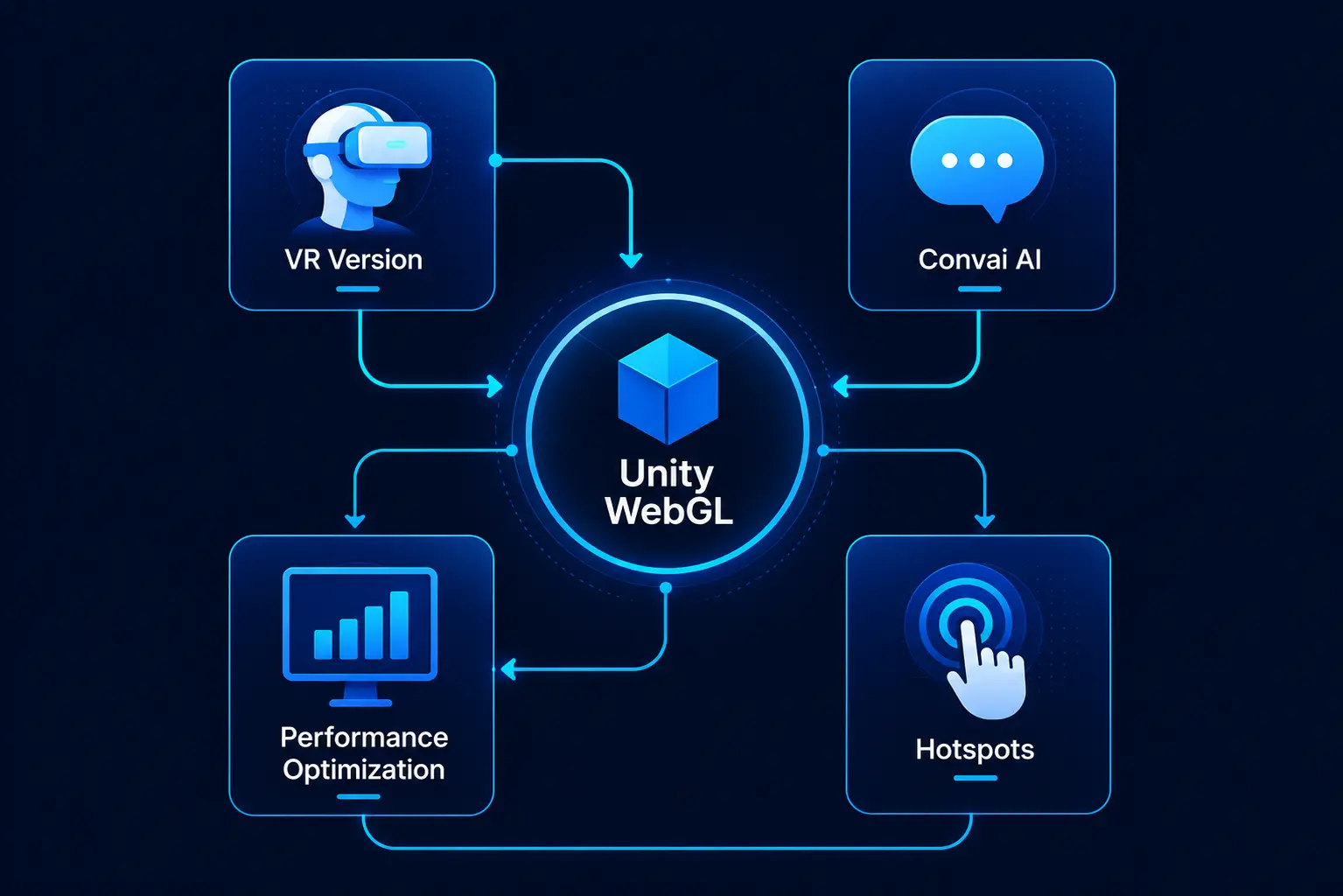
Acme One developed a cross platform digital twin for the Houston Advanced Research Center (HARC) to make its sustainability campus accessible from anywhere. Built with Unity, the solution enables visitors to explore the property through WebGL and VR, access technical documents directly from interactive 3D objects, and provides a scalable platform for future AI guided experiences. Today, the application is actively used for outreach, education, and stakeholder presentations from a single shared codebase.

Key Results

  • One Unity project deployed to 2 platforms (WebGL and VR).
  • 120+ interactive objects connected to technical documentation.
  • 500+ acres/building components digitally recreated.
  • Reduced content update effort by 80% through JSON driven content management.
  • Maintained 60 FPS on supported VR hardware.
  • Used by 100+ stakeholders during outreach events.

What challenges did HARC face when building a cross platform digital twin?

The Houston Advanced Research Center wanted people to explore its sustainability campus without physically visiting the site. The experience needed to work equally well in both desktop browsers and VR headsets while maintaining consistent visuals, interactions, and performance.

The project introduced several technical challenges:

  • Supporting WebGL and VR from the same Unity project while optimizing each platform independently.
  • Allowing users to open technical PDFs directly from interactive 3D objects without disrupting the experience.
  • Creating platform specific navigation using teleportation for WebGL and natural climbing mechanics for VR.
  • Optimizing trees and vegetation for smooth browser performance without sacrificing
  • Designing the architecture to support future AI powered virtual guides and narrated tours without major redevelopment.

Goals & Objectives

The project aimed to:

  • Enable remote exploration of the HARC facility.
  • Showcase renewable energy systems through immersive experiences.
  • Provide direct access to technical documentation.
  • Support both browser based and VR experiences.
  • Build a scalable foundation for future AI powered features.
How did Acme One build one experience for both WebGL and VR?
  • Acme One developed the solution in Unity using a modular architecture that allowed a shared project to support both WebGL and VR while delivering interactions optimized for each platform.
  • Interactive hotspots were created throughout the environment. In WebGL, users hover over objects to access technical PDFs in a browser tab. Every hotspot references shared JSON data, allowing HARC to update documents without modifying application code.
  • For VR, the team designed a gaze based interaction system that displays contextual information and document links directly inside the virtual environment, preserving immersion.
  • Navigation was tailored for each platform. Browser users can instantly teleport to rooftop solar installations, while VR users climb a virtual ladder for a more realistic experience.
  • To improve performance, vegetation assets were rebuilt using lightweight billboard LODs and optimized normal maps, significantly reducing rendering overhead while maintaining visual quality.
  • The application was also designed with modular managers, allowing future integration of Convai powered AI guides and narrated tours without rebuilding the system.

How was the project Implemented?

The implementation followed a structured development process:

  • Planned a shared Unity architecture for WebGL and VR deployments.
  • Built a centralized JSON driven hotspot framework.
  • Developed platform specific interaction systems.
  • Optimized environmental assets for smooth performance.
  • Designed modular components for future scalability.
  • Tested both platforms in parallel to validate functionality and performance.

What business outcomes did the digital twin deliver?

Single Unity Application Deployed to WebGL and VR

Interactive Access to Technical Documents

Consistent Experience across Browsers and VR

Optimized Performance for Outdoor Environments

Ready for Future AI Guides and Narrated Tours

Used for Outreach, Education, and Presentations

What business outcomes did the digital twin deliver?

Single Unity Application Deployed to WebGL and VR

Interactive Access to Technical Documents

Consistent Experience across Browsers and VR

Optimized Performance for Outdoor Environments

Ready for Future AI Guides and Narrated Tours

Used for Outreach, Education, and Presentations

What Our Client Says

Don’t just take our word for it. Hear what our satisfied clients have to say about their experience partnering with ACME ONE


"We wanted people to understand our building and the renewable energy work happening here, even if they could never visit the campus. This platform makes that possible. Visitors can explore the property, access real technical documents, and better understand our mission. It has become a valuable tool for outreach, education, and stakeholder engagement."

Program Director
Houston Advanced Research Center (HARC)

Get In Touch With Us Today

We’re here to help! If you have any questions or would like to discuss.

Contact Info

We’re here to help! If you have any questions or would like to discuss how our IT services and technology solutions can benefit your business,

Our Location

Meydan – Nad Al Sheba – Dubai – United Arab Emirates

Phone Number

+971 50 952 6681

Email Address

info@acme-one.com

Working Hours

Monday - Friday: 9.00 - 6.00
Saturday & Sunday (Closed)

Get In Touch

We’re here to help! If you have any questions or would like to explore how our custom software, digital solutions, and IT expertise can support your business growth.