Automation is something every organization can afford and make the best use of. In 2026, businesses of every size, from a co-founder running lean to a global enterprise managing thousands of processes, are using artificial intelligence to handle the sharpen decision-making and give their people back the time they need to focus on what matters.
Here is the part most vendors will not tell you upfront: a lot of these platforms are disappointing. The demo looks refined. The sales pitch is compelling. Then the tool goes live, the edge cases begin accumulating, and the team is now spending half its time managing the tool instead.
Choosing the wrong automation software does not just waste money. It channels the energy of the people who championed the project, deteriorates the confidence in future technology investments, and leaves your business further behind than if you had waited and chosen more carefully.
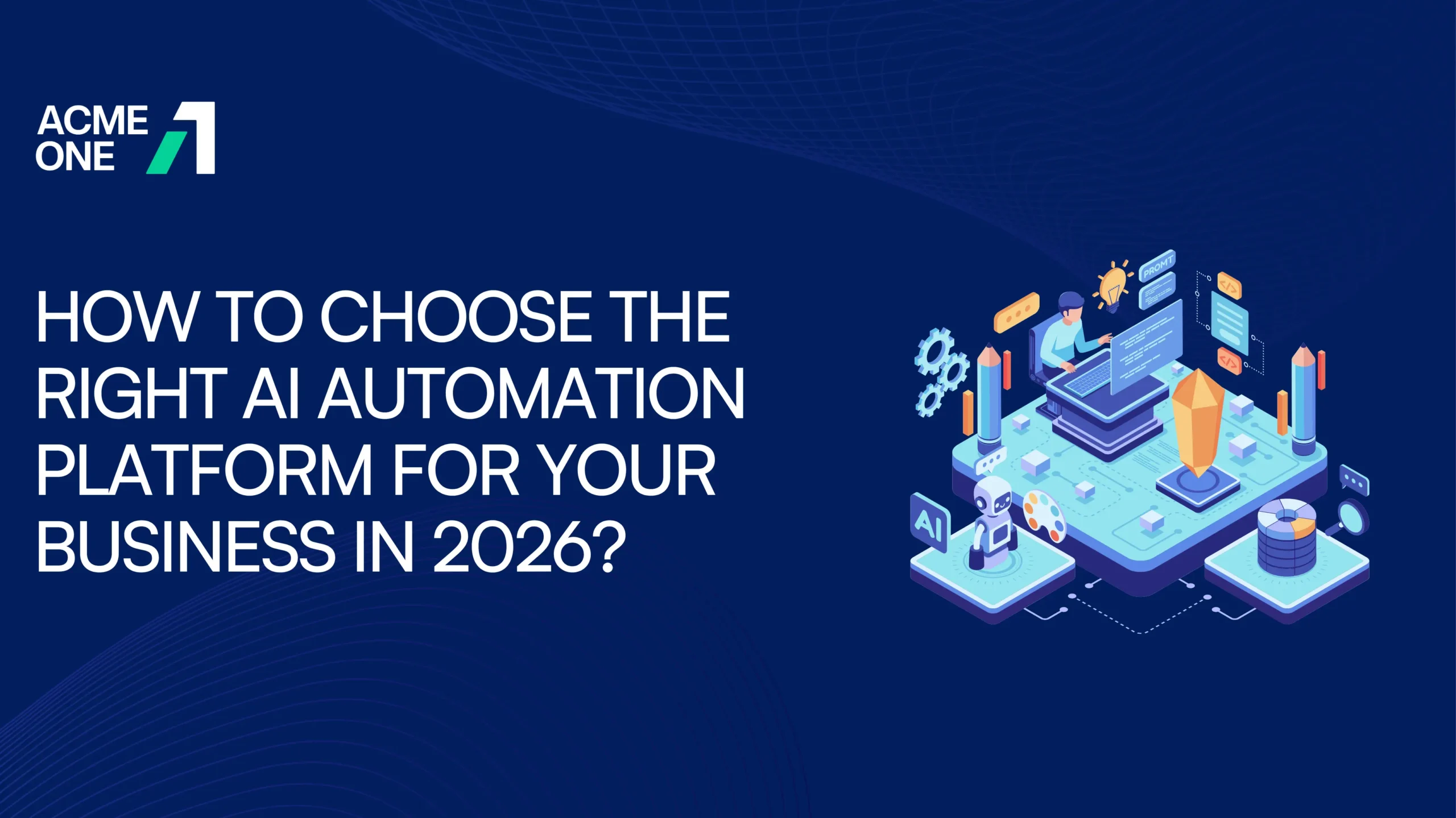
In this blog, let’s discuss how to choose the most appropriate ai automation platform. This guide exists to help you to be clear about that outcome. Whether you are a startup exploring automation for the first time or an enterprise evaluating AI automation solutions for a full-scale activation, what follows is a practical, honest framework for deciding that you will not face problems for the next six months down the line.
What Is an AI Automation Platform?
An AI automation platform is a system that uses artificial intelligence, such as machine learning, natural language processing, computer vision, or a combination, to automate tasks, processes, and decisions. AI-powered platforms can handle deviations, learn from data, and enhance their performance over time.
The contrast matters as it defines what the platform can and cannot do. A rule-based tool automates what you categorically program. An AI automation system handles the unexpected routing of emails it has never seen before, collecting data from documents with inconsistent formats or identifying issues in tasks that follow no fixed pattern.
Modern AI-powered workflow automation software covers some combination of the following capabilities:
- Process discovery and mapping.
- Robotic Process Automation (RPA) with AI enhancements.
- Natural language interfaces for building and managing tasks.
- Predictive analytics and intelligent decision routing.
- Incorporation with enterprise systems (CRM, ERP, HRIS, communication tools).
- Live monitoring and performance analytics.
Understanding which of these capabilities your business actually needs is the initial step toward choosing the right platform.
Why Is Choosing the Right AI Automation Platform So Important?
The transition costs are high. As you have built tasks on a platform, trained your team, and merged it with your primary business systems, moving to a different platform is expensive and disruptive. Getting the initial choice right saves a lot of time.
The operational gain is immense if you get it right. Businesses mostly successfully implement AI-powered tasks, while reporting reductions in turnaround time of 60 to 80 percent. All this reduction occurs in targeted areas. For high-volume processes such as invoice processing, customer onboarding, support ticket routing, and regulatory supervision, the ROI is often measured in weeks, not years.
The risk of getting it wrong is real. Poorly implemented automation can introduce new errors, create regulation gaps, and damage customer experiences in ways that are harder to fix than the manual processes they replaced. Business process automation (BPA) is fundamental and must be implemented properly. In case BPA is done poorly, it exacerbates problems.
Key Factors to Consider When Choosing an AI Automation Platform
Define Your Functional Requirement Before You Assess Any Platform
The market for AI automation platforms for business tools is comprehensive enough that the right choice for a law firm’s document processing workflows is completely different from the right choice for a manufacturing company’s quality assurance processes. Before you look at a single vendor, define:
- Which specific processes are you automating first?
- What is the current volume and frequency of those processes?
- What data sources and systems does the automation need to connect with?
- Who will build and maintain workflows, such as technical developers or business users?
- What does success look like in 90 days?
These answers will help you evaluate the remaining options against criteria that matter to your situation.
Assess Integration Depth with Your Existing Systems
An automation platform that cannot connect reliably to your current tools is not an automation platform; it is an extra cache. Enterprise software integration is a feature considered to be very important. It is the foundation on which everything else depends.
When evaluating cloud-based AI automation tools, look carefully at:
- Native connectors to your primary systems.
- API quality and documentation for custom integrations.
- Support for standard protocols.
- Data transformation capability between systems with different schemas.
- Real-time vs. batch integration support.
The deeper and more reliable the combination layer, the more value you will collect from every task you build on top of it.
Evaluate the Balance Between No-Code and Developer Flexibility
One of the most important dimensions of AI automation platform selection is cultivating expertise, and those who can build tasks and how.
No-code and low-code platforms empower automation by enabling business users to build their own tasks without engineering support. That sounds appealing, and for straightforward use cases, it absolutely is. The complex workflows, those involving conditional logic and compliance requirements, often hit the roof of visual builders and require either bypass or a platform to rebuild.
When evaluating AI workflow automation software, look for:
- Visual workflow builders with sufficient logical depth for your complexity level.
- Developer APIs and SDKs for extending what the visual builder cannot handle.
- Version control and testing environments for workflow management.
- Role-based access controls for managing who can build, modify, and deploy automations.
The best platforms for most mid-market and enterprise organizations offer both a no-code layer for speed and a developer layer for depth.
Scrutinize AI Quality and Explainability
Not all AI is equal. When a platform says it uses AI, the critical question is: what kind, for what purpose, and how good is it?
For enterprise AI automation solutions, AI quality has two dimensions that matter for business deployment. The first is accuracy, which involves: does the model perform well enough on your actual data and use cases to be trusted in production? The second is explainability that when the system decides or flags an anomaly, can it show you why?
Interpretability matters after transfer. In regulated industries, digital decisions often need to be justified. In any industry, analyzing automation failures that are behaving unexpectedly requires understanding what the core frameworks are doing and why.
Ask vendors directly: how does your AI model demonstrate its decisions? What is your model accuracy benchmark on real customer data? How do models improve over time, and what triggers retraining?
Examine Security and Compliance Architecture
This is the question that separates serious enterprise platforms from tools built for SMB convenience.
Secure AI automation solutions for enterprises need to address:
- Data encryption at rest and in transit.
- Role-based access control and identity management.
- Audit logging for all automation activity.
- Data residency and self-rule for multi-national deployments.
- Vendor security certifications (ISO 27001, SOC 2 Type II, GDPR compliance).
For healthcare, finance, legal, or government, these are not optional. They are basic requirements you must meet. These are critical requirements, not trade-offs. If a platform cannot meet them, it is not a viable choice.
Best AI Tools for Workflow Automation in 2026: What to Look for by Business Size
For Startups
Which AI automation platform is best for startups? The answer focuses on speed, cost, and ease of use over depth. Startups benefit from tools with flexible pricing and no-code builders. Pre-built templates for common tasks make it easier to get started. Various companies, such as ACME One, provide AI automation services to their clients.
The right platform for a startup delivers value in the first two weeks without requiring a dedicated engineer to operate it.
For Small and Mid-Market Businesses
Choosing the best AI automation platform for a small business involves a different trade-off. SMBs need more advanced tools than startups. But they usually lack the technical depth of large enterprises. Choose platforms with strong integrations and simple interfaces. Make sure they can grow with your needs. Pricing predictability matters for businesses that handle tight operational budgets.
For Enterprises
Enterprise buyers need platforms that meet strict security and compliance needs. They should handle complex workflows and offer strong support for rollout and scaling. The evaluation should include IT, legal, and compliance teams. They need to work alongside business stakeholders, leading the decision.
What are the risks of using AI automation tools?
These risks involve excessive streamlining of complex processes. Not every task should be automated. Avoid automating tasks that need human judgment. This includes critical decisions, sensitive customer communication, and complex exceptions. All of these processes can cause damage to relationships and trust.
Data quality dependency
AI automation is only as good as how well the data is processed. Poor data quality upstream produces unreliable automation outcomes downstream. Before transferring, audit the quality of the data sources your tasks will depend on.
Change management underestimation
Technology adoption fails most often due to the lack of appropriate preparation for the people using it. Automation changes how teams work. That shift needs clear communication, training, and steady support to last.
Vendor lock-in
The incorporation with a proprietary platform can become costly if a better option emerges. Evaluate the platform structure’s openness before committing.
Security exposure
Mechanization that processes crucial data across various systems enhances vulnerability exposure. Every combination point is a potential liability. Treat security tests as a crucial part of the evaluation process.
Final Remarks
Selecting an AI automation software is not a technology decision. This business decision comes with technological consequences. The value of any platform depends on how clear your goals are. It also depends on how carefully you evaluate your options. And most of all, how committed your team is to using it well.
The businesses that get the most from and ai automation platform for business investments are not necessarily the ones that choose the most sophisticated tool. They choose the right tool for their needs and implement it properly. They train their teams and keep improving based on real data.